-
여성
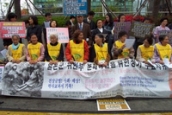
- 일본군 '위안부'문제 해결을 위한 제 555차 정기수요시위
- 4월 23일 정오, 일본 대사관 앞에서 일본군'위안부'문제 해결을 위한 제555차 정기수요시위가 KNCC 여성위원회 주관으로 열렸다.
이날 시위는 위안부 할머니 13분을 포함해서 40여명 참가한 가운데, 일본 정부에게 ILO와 UN의 권고사항을 조속히 이행할 것을 강력히 촉구하였다.
일본군'위안부'문제
해결을 위한 제555차 정기수요시위
일시:
2003년 4월 23일(수) 정오
장소:
중학동 일본대사관 앞
주관:
한국기독교교회협의회(KNCC) 여성위원회
■
순서
사회
/ 정해선 부장(KNCC 여성위원회)
활동경과보고
/ 윤미향 사무처장(정대협)
참가자
자유발언
특송
/ 암하렛츠
말씀
/ 김혜숙 목사(KNCC 여성위원회 위원, 새가정사 총무)
성명서
낭독 / 박수현 목사(KNCC 여성위원회 위원, 한국기독교장로회 여교역자협의회 총무)
구호제창
광고
■
우리의 요구
1.
반인권, 반여성적 국가범죄에 대해 공식사죄하라.
1.
일본정부는 완전한 법적배상을 실시하라.
1.
일본정부는 왜곡된 역사교육을 중단하라.
일본군'위안부'문제해결을
위한 제555차 정기수요시위 성명서
이라크전에서
무고하게 죽어간 민간인, 여성과 아동의 고통을 생각하면서 이 전쟁을 막지 못한
우리의 죄를 고백한다.
미국이
전 세계의 경제적, 정치적 지배권을 갖기 위해 '충격과 공포' 작전으로 이라크를
초토화함으로써, 우리가 희망한 정의를 바탕으로 한 세계평화와 질서를 무참히 무너뜨렸다.
오만한 미국의 군사적 행동은 이라크 국민들의 숨통을 조이고, 5천 여명의 사상자를
냄으로써 이라크 사회와 가정을 철저하게 붕괴시켰다. 우리 기독여성들은 이 전쟁을
막지 못한 죄를 고백하며, 하루속히 이라크 국민들이 일상의 삶으로 돌아갈 수 있도록
최선의 노력을 다할 것이다. 또한 우리는 거대한 자본의 힘으로 한 국가를 철저히
짓밟은 미국의 패권주의를 바라보면서 우리가 겪은 과거 일본의 식민지 역사를 잊을
수 없다.
일본정부는
일본군'위안부' 제도가 여성에게 행해진 폭력을 넘은 전쟁범죄이며, 인도주의에 반한
국제적 범죄행위임을 자인하고 공식사죄 할 것을 촉구한다.
태평양과
아시아 지배를 위한 과거 일본의 군사적 행동은 '위안부' 여성의 육체적, 정신적,
심리적 건강한 삶을 송두리째 빼앗아 갔다. 군사주의에 의한 전쟁이나 무력충돌의
결과, 언제나 여성은 피해자의 위치에 서있다. 일본이 한국여성들에게 행한 폭력은
분명 조직적이고 의도된 국제범죄이기에 공식사죄를 촉구한다.
일본정부는
피해자와 관련한 법적 책임을 '완전히' 이행할 것을 촉구한다.
지난
3월 26일, 일본 최고재판소는 일본군'위안부'와 관련하여 성적강제에 대한 일본정부의
법적 책임이 없다는 최종판결을 내렸다. 또한 4월 11일 제59차 유엔인권위원회 회의에서,
유엔특별보고관의 법적책임 권고 불이행에 대한 한국정부의 우려에 대하여 일본정부는
이미 법적보상 책임을 완전히 그리고 최종적으로 해결했다고 주장하였다. 우리 기독여성들은
일본정부가 반여성적 범죄행위에 대한 법적책임을 완전히 이행할 것을 촉구하며,
더불어 노무현 정부가 동등한 한일간의 외교관계를 통해 일본군'위안부'문제해결을
정정당당하게 요구할 것을 촉구한다.
과거
잘못에 대한 성찰과 책임지는 행동을 보여주지 않는 일본정부는 과거뿐만 아니라
지금 이 순간에도 패권전략으로 아시아인들과 한국인의 평화적 생존권을 박탈하고
있다. 우리 기독여성들은 일본군'위안부'의 완전한 해결없이는 아시아의 평화와 한반도의
안보 또한 보장할 수 없음을 명심하고, 지난 13년간을 외롭게 싸워온 위안부 할머니들의
권리찾기를 위한 일에 앞장설 것임을 밝힌다.
2003년
4월 23일
일본군'위안부'문제해결을
위한 제555차 정기수요시위 참가자 일동
한국기독교교회협의회
여성위원회
2003-04-23 05:59:48
-
정의·평화
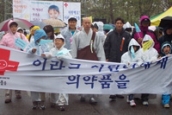
- 어린이들과 함께하는 평화의 행진 - 사랑해요! 이라크 친구들
- 전쟁으로 인해 이라크의 많은 사람들, 특히 어린이들의 피해가 점점 더 늘어나고 있는 상황에서 한국기독교교회협의회, 한겨레신문사, 한국불교종단협의회, 천주교주교회의 주최로 "사랑해요! 이라크 친구들"이라는 제목으로 어린이들과 함께하는 평화의 행진이 4월 20일(부활주일) 오후 3시 남산 백범광장에서 열렸다.
이날 행사는 날씨 관계로 많은 사람들이 참석하지는 못했으나 약 140여명의 뜻있는 사람들이 모여 평화의 행진을 진행하였다. 행사의 개요와 프로그램은 아래와 같다.
◈ 행사개요
¤ 일시 : 2003년 4월 20일(일) 3시∼5시
¤ 장소 : 남산 백범광장, 이슬람 성원
¤ 참가대상 : 종교인 및 이라크인과 무슬림, 어린이
¤ 주최 : 한겨레신문사, 한국기독교교회협의회, 한국불교종단협의회, 천주교주교회의
¤ 주관 : 건강권 실현을 위한 보건의료단체연합, 남북어린이어깨동무, 의약품지원본부, 여성단체연합, 평화를 만드는 여성회, 한겨레통일문화재단
◈ 프로그램
¤ 1부 : 평화의 마당(15:00∼15:30)
1) 장소 : 백범광장
2)프로그램
- 나눔과 평화의 메시지 : 최일도 목사
- 참석자 소개
- 캠페인 진행 경과 설명 : 치과의사 장현주
- 평화의 노래공연1 : 아름나라(월곡교회어린이)
- 대국민 호소문 낭독 : 이라크 어린이에게 의약품지원 모금 참여 호소 - 성관 스님
- 어린이의 우정의 편지낭독
- 평화의 노래 공연 2 : 작은세상외 1곡(월곡교회 어린이)
¤ 2부 : 평화의 발걸음(15:30∼16:30)
남산 백범광장 - 남산길 - 이슬람 사원(3㎞)
¤ 3부 : 화합의 마당(16:30∼17:00)
1)장소 : 이슬람 성원 앞뜰
2)프로그램
- 평화의 리본달기와 사원둘러보기 : 평화의 메시지를 적은 리본을 이슬람사원에 달고 사원을 직접 둘러본다.
- 참가한 이라크인과 무슬림 소개
- 평화와 화해 청하기와 묵념 : 어른들의 잘못으로 희생된 이라크 어린이에게 용서를 청하고 묵념한다.
- 어린이들의 평화의 메시지를 무슬림들에게 전달 : 어린이들이 준비한 메시지와 선물을 참가한 무슬림들에게 대신 전달
- 마침 : 평화의 인사
2003-04-21 04:49:58
- 에큐메니칼 사전 이달의 주제 시리즈 : 2003년 2월 동방정교회
-
ecumenical
dictionary
"ARTICLE
OF THE MONTH" SERIES
February
2003: "Eastern Orthodoxy". Author: Nicholas LOSSKY
EASTERN
ORTHODOXY
In
recent times, this term has come to be used, particularly in the ecumenical
context, to refer to the “Chalcedonian” Orthodox as distinct from the “non-”
or “pre-Chalcedonian” churches, known as “Oriental Orthodox churches”.*
Eastern
Orthodox churches are identified with the East through a series of historical
accidents, involving the gradual estrangement between Rome (and Western Christendom)
and the other ancient patriarchates. In reality, Orthodoxy* does not consider
itself either Eastern or Western. Until the schism* between East and West became
a final reality, Eastern and Western Christianity, with tensions from time to
time, were one conciliar communion* (with the exception of the pre-Chalcedonians
from the 5th century onwards).
The
date of 1054, usually given as that of the separation, is that of an exchange
of excommunications* between Rome and Constantinople (the “New Rome” since
the first council of Constantinople,* 381). The process leading to the schism
was in fact long and complicated, and in spite of attempts at reunion (councils
of Lyons, 1274, and Ferrara-Florence, 1438-39), it still remains unhealed. However,
relations have changed considerably in recent decades, particularly in 1965,
when Pope Paul VI and Patriarch Athenagoras I mutually lifted the excommunications
of 1054. An official international dialogue commission has been at work for
some years now (see Orthodox-Roman Catholic dialogue).
The
Eastern Orthodox claim a direct, unbroken descent from the church of the apostles.
This is expressed in their fidelity to the apostolic faith as developed in the
seven ecumenical councils* and the patristic tradition (see apostolic Tradition,
apostolicity). Thus, the Eastern Orthodox churches are united in the faith,*
and each one has internal autonomy under the primacy* of the patriarchate of
Constantinople, the “first among equals”.
Orthodoxy
also implies a strong attachment to the sacraments,* the most important being
the sacraments of initiation: baptism* (by immersion), chrismation* and the
eucharist* (communion in both kinds), to which the newly baptized member is
immediately admitted, whatever his or her age.
Since
the separation from the Christian West, Eastern Orthodox churches have mainly
been using the Syro-Byzantine liturgical tradition (see liturgy), whose development
owes much to the fathers and the great monastic centres (today, Mt Athos is
the most important of these). In this liturgical tradition iconography plays
an important part (see icon/image).
Structurally,
Eastern Orthodox churches currently fall under the following classifications.
They represent four out of the five ancient patriarchates which, together with
Rome, formed the famous pentarchy, i.e. Constantinople (Patriarch Bartholomew
I; some 2 million faithful, with only a few thousand in Turkey); Alexandria
(Patriarch Peter VII; about 100,000 faithful); Antioch (primatial see, Damascus:
Patriarch Ignatius IV; some 450,000 faithful); and Jerusalem (Patriarch Irineos
I; about 50,000).
Orthodoxy
includes a number of other autocephalous churches (i.e. churches that elect
their own primate without reference to another autocephalous church). The largest
of all is the church of Russia (Patriarch Alexis II; about 100 million faithful
in 1917, approximately the same number baptized today). Others are the Romanian
church (Patriarch Theoctist; some 14 million); the Serbian church in ex-Yugoslavia
(patriarchate in Belgrade: Patriarch Pavle; some 8 million); the Church of Greece,
distinct from the patriarchate of Constantinople since 1833, with its own primate,
the archbishop of Athens (Christodoulos; about 7.5 million faithful); the Bulgarian
church (Patriarch Maximos; some 6 million); the church of Georgia, much more
ancient than the Russian church, having been founded in the 5th century as a
result of missionary work by a woman, St Nino, counted as “equal to the apostles”
in the Orthodox sanctoral (Patriarch Catholicos Elias II; 2.5 million faithful
in 1917); the church of Cyprus, autocephalous since the council of Ephesus in
431 (Archbishop Chrysostomos; some 450,000 faithful).
A
third type are autocephalous churches which represent a minority among other
Christians in their territory, namely, the Orthodox Church of the Czech Lands
and Slovakia (some 350,000 faithful in 1950); the Orthodox church in Poland
(about 350,000); the Orthodox Autocephalus Church of Albania (about 210,000
faithful in 1944, now developing once again under the leadership of Archbishop
Anastasios.
Orthodoxy
also includes autonomous or semi-autonomous churches (i.e. churches that enjoy
internal autonomy but whose primate is elected under the aegis of one of the
autocephalous churches. Among them are the church of Finland (some 70,000 faithful,
under the jurisdiction of Constantinople); the church of Crete (also under Constantinople);
the Orthodox Church of Japan (about 36,000 faithful, under the jurisdiction
of Moscow); the Russian Orthodox mission in China (probably some 20,000 faithful).
Another
classification is missions which are not yet autonomous. These include the Russian
mission in Korea (under the jurisdiction of the Greek Archdiocese of North America)
and African Orthodoxy (founded in Uganda by dissidents from Anglicanism, now
present also in Kenya, Democratic Republic of Congo, Ghana and Zimbabwe, under
the jurisdiction of the patriarchate of Alexandria).
Finally,
there is the Orthodox diaspora.* In the 19th and 20th centuries, many Orthodox
emigrated to Western countries for economic and political reasons. As a result,
Orthodox are now to be found in most parts of the world.
Although
the principle of identifying Orthodoxy with an ethnic group was condemned as
a heresy* in 1872 under the name of “phyletism” by a synod held in Constantinople
(but received by all Orthodox churches), the present situation resembles a complicated
jigsaw puzzle of numerous jurisdictions in most countries of the Western world,
where the Orthodox of various origins tend to be claimed by their mother churches
according to their ethnicity.*
According
to traditional Orthodox ecclesiology, all the Orthodox in a given place, whatever
their ethnic origin, should be gathered in one conciliar communion. Such, for
example, was the situation in the US until 1917: all the Orthodox were in one
diocese, which had grown from the Russian mission among the Aleutian and Alaskan
Indians in the 18th century. At the council of Moscow in 1917, Tikhon, formerly
bishop of the American diocese (recently canonized), was elected patriarch.
When he was able to send a new bishop to New York a few years later, the latter
found that in the meantime all the mother churches of the Orthodox world had
claimed their nationals and created their own jurisdictions. In 1970, the Russian
church granted autocephaly to the churches of its old diocese in America, thus
creating the Orthodox Church in America (primate: Metropolitan Theodosius).
However, finding the solution to the problem of the Orthodox diaspora remains
one of the main difficulties of present-day Orthodoxy, one that is high on the
agenda of the pan-Orthodox council. Recently the churches have moved towards
a consensus in this area.
Eastern
Orthodox churches have played a part in the ecumenical movement from early in
the 20th century. Witness the encyclical* letter of the Ecumenical Patriarch
of Constantinople in 1920 to “all the churches of Christ” for “closer intercourse
and mutual cooperation”. The Orthodox diaspora has also greatly contributed
to an encounter with Western Christendom, to better mutual understanding, and
to a common renaissance in patristic theological reflection. Most Eastern Orthodox
churches have become members of the WCC and have established bilateral dialogues*
with most Christian churches. Orthodoxy, however, does include a certain anti-ecumenical
strain which is largely due to a suspicion on the part of some that ecumenical
dialogue necessarily implies a betrayal of the purity of the Orthodox faith.
Under the influence of this trend, the Orthodox churches of Georgia and Bulgaria
left the WCC in 1998.
Eastern
Orthodox churches do not believe in “intercommunion”;* in their view, only
full communion* has a meaning. This is the main reason why the Orthodox generally
have refused to practise so-called eucharistic hospitality. In their conception
of the nature of the church,* communion is only possible when the apostolic
faith can be fully confessed together. (Some pastors do practise eucharistic
hospitality in specific circumstances, but only as a matter of conscience in
their personal pastoral responsibility.) For the time being, Eastern Orthodox
churches are not prepared to sanction a generalized eucharistic hospitality,
not even as a measure of economy.* Indeed, such a step would amount to establishing
a rule, and the principle of economy is precisely a pedagogical exception to
a rule which in no way abolishes the existing rule. In the Orthodox perspective,
full communion will quite naturally be restored when it is truly possible to
confess the fullness of the apostolic faith together.
See
also Orthodoxy.
NICHOLAS
LOSSKY
S.
Bulgakov, The Orthodox Church, London, Centenary, 1935 ¦ O. Clément,
L’Eglise orthodoxe: Que sais-je?, rev. ed., Paris, PUF, 1985 ¦ P. Evdokimov,
L’orthodoxie, Paris, Desclée de Brouwer, 1979 ¦ J. Meyendorff,
The Orthodox Church: Its Past and Its Role in the World Today, rev. and expanded
by N. Lossky, New York, St Vladimir’s Seminary, 1996 ¦ A. Schmemann,
The Historical Road of Eastern Orthodoxy, New York, St Vladimir’s Seminary,
1977 ¦ T. Ware, The Orthodox Church, updated ed., Harmondsworth, UK,
Pelican, 1993.
2003-04-11 01:33:35
- 에큐메니칼 사전 이달의 주제시리즈 : 2003년 1월 종교간대화
-
ecumenical
dictionary
"ARTICLE
OF THE MONTH" SERIES
January
2003: "Dialogue, interfaith ". Author: S. WESLEY ARIARAJAH
DIALOGUE,
INTERFAITH
The
struggle to comprehend the relationship between Christianity and other religious
traditions has been an important issue from the beginnings of the church.* Christian
faith* was born in a Jewish milieu. Inevitably it soon came into contact with
the Graeco-Roman world. When persons who were not of Jewish origin became Christians,
controversy erupted over the basis of their common life in a religious community
made up of Jews and Gentiles (Acts 15; Gal. 2). In his letter to the Romans,
Paul seeks to clarify theologically the relationship between the Jewish religious
tradition and the Christian faith, which by then were beginning to be seen as
two distinct religious groupings. Writing to the Corinthians, Paul gave pastoral
advice to people who had become followers of Christ but had partners in marriage
who continued to remain in another religious tradition (1 Cor. 7:12-16).
The
writings of the early church also show that there were divergent schools of
thought on how to understand and relate to religious life that was not based
on Christian convictions. The history of Christianity is also the history of
Christian relationships, for the most part conflictual, with other faith traditions.
This survey confines itself to the period of the modern ecumenical movement
and to the development of the concept and practice of interfaith dialogue inspired
by and structured within it.
Historical
background
The
world missionary conference at Edinburgh in 1910 is commonly accepted as marking
the beginning of the modern ecumenical movement. This conference appealed to
the 1200 delegates sent by missionary societies and so-called younger churches
(a total of only 17) to bring about the evangelization of the world in that
generation.
The
question of Christian understanding of and relationship to other religious traditions
was a central issue in Edinburgh, and the section that dealt with the missionary
message in relation to non-Christian religions was by common consent the finest
of all the reports produced at Edinburgh. It spoke of the Christian encounter
with the religious traditions of Asia, for example, as being of the same order
as the meeting of the New Testament church with Graeco-Roman culture, demanding
fundamental shifts in Christian self-understanding and theology. While the evangelistic
thrust predominated in the overall Edinburgh message, the discussions there
stimulated scholarly interest both in comparative religion and in exploring
the Christian relation to other faith traditions. An influential book of the
period was J.N. Farquhar’s The Crown of Hinduism, which argued that Christ
fulfilled the longings and aspirations of Hinduism.
By
the time of the next international missionary conference (Jerusalem 1928), considerable
controversy had arisen within the missionary movement over the approach to other
religious traditions. Some European theologians detected in liberal Protestantism,
especially in the USA, troubling arguments, however tentative, in support of
a universal religion.* There was also deep concern that what was considered
“syncretistic thinking” with regard to Asian religions was undermining the
importance and urgency of Christian mission.* But the issue that dominated the
Jerusalem meeting was rising secularism in both East and West (see secularization).
While asserting that the Christian gospel provided the answers to a troubled
world, the conference affirmed the “values” in other religions and called
on Christians to join hands with all believers to confront the growing impact
of secular culture.
But
some participants could not agree with Jerusalem’s positive affirmation of
other faiths and maintained that the Christian gospel is unique among religious
traditions. Thus, even though the message was unanimously accepted (largely
due to the drafting skills of William Temple), the Christian attitude to other
faiths became a highly controversial issue shortly after the Jerusalem meeting.
At the heart of the post-Jerusalem dispute was the Report of the Commission
of Appraisal of the Laymen’s Foreign Mission Enquiry, edited by W.E. Hocking,
which criticized the exclusive attitude of Christians towards other faiths and
claimed that the challenge to the Christian faith came not from other faiths
but from anti-religious and secular movements. In response, the leadership of
the missionary movement commissioned Hendrik Kraemer, the well-known Dutch missiologist
then working as a missionary in Java, to write a book on the biblical and theological
basis of the Christian attitude to other faiths. Kraemer’s The Christian Message
in a Non-Christian World became the preparatory study book for the next international
missionary conference in Tambaram, India, in 1938.
Kraemer,
following Karl Barth, insisted that the biblical faith, based on God’s encounter
with humankind, is radically different from all other forms of religious faith.
Admitting that God’s will shines through, albeit in a broken way, in the all-too-human
attempts to know God in all religious life, Kraemer maintained that the only
true way to know the revealed will of God is by responding to the divine intervention
in history in Christ. Both Barth and Kraemer considered Christianity as a religion
to be as human as any other. But neither could avoid giving, at least by implication,
a unique place to Christianity in so far as it had become the vehicle through
which the unique revelation* of God is lived and proclaimed.
Despite
Kraemer’s impact on Tambaram and subsequent missionary thinking, there were
many dissenting voices. A.G. Hogg, H.H. Farmer, T.C. Chao and others challenged
Kraemer’s view that the gospel was in discontinuity with other religious traditions.
They witnessed to what they were convinced was a “two-way traffic” between
God and the human soul in the religious life and experience of others. It was
inconceivable to them that God had no witnesses among the nations of the earth.
All participants agreed on the special revelatory character of the Christ event,
but many had difficulty with Kraemer’s view of religions as “totalitarian
systems” of human thought and practice. Thus, although the Tambaram report
leaned heavily towards Kraemer’s views, it acknowledged that “Christians are
not agreed” on the revelatory character of other religious traditions and identified
this as “a matter urgently demanding thought and united study” within the
ecumenical movement.
Post-Tambaram
developments
Not
long after Tambaram, Europe became embroiled in the second world war, and other
concerns demanded the attention of the missionary movement. When the International
Missionary Council* (IMC) turned its attention again to Christian relations
to other faith traditions once the war was over, it was a different world. Nationalism
was sweeping through the newly independent states in Asia and Africa, and with
it came a revival of religious traditions. The churches, awakened to the need
to express their unity in a world shattered by war, had come together in Amsterdam
in 1948 to form the WCC. Both the IMC and the WCC’s department on evangelism
were eager to follow up on the unfinished Tambaram debate on other faiths.
One
of the strategies adopted was to set up a number of study centres around the
world that would address the question in concrete historical situations. Another
was a long-term joint study on “The Word of God and the Living Faiths of Men”,
which sought to take the discussion beyond Tambaram and the continuity-discontinuity
polarity.
A
great deal of attention was focused on Asia, where outstanding work on the issue
was carried out by Paul Devanandan, D.T. Niles, Sabapathy Kulendran and others.
Devanandan’s address to the New Delhi assembly of the WCC (1961) ? at which
the IMC was integrated into the WCC-challenged the churches to take seriously
the experience of the younger churches in the newly independent countries, where
they had to work and struggle together with peoples of different religious traditions
in nation-building.
In
this context the concept of dialogue appears in the New Delhi statement as a
way of speaking about Christian relations with people of other faith traditions.
This was further considered at the first world mission gathering under WCC auspices
in Mexico City in 1963. A more significant discussion took place at the East
Asia Christian Conference assembly in Bangkok in 1964. Its statement on “Christian
Encounter with Men of Other Beliefs”, incorporating much of the re-thinking
in Asia in relation to other faiths, took the debate at many points beyond the
Tambaram controversy.
A
WCC conference in Kandy, Sri Lanka, in 1967, proved to be a landmark both as
the beginning of serious interest in interfaith dialogue as such in the WCC,
and as the first involvement in the ecumenical discussion of the Vatican Secretariat
for Non-Christians. In Kandy Kenneth Cragg challenged in a fundamental way the
Barth-Kraemer attitude to religions that had so dominated Protestant thinking
during the previous decades.
Developments
within the Roman Catholic Church
There
were in fact significant differences between Protestants and Roman Catholics
in their general theological orientation towards other religions. The Protestant
missions tended to place enormous emphasis on Christology and on the need to
respond to the message of the gospel as a way to salvation.* While the attitude
to other faiths had not always been negative, it had tended to be neutral at
best on the question of salvation outside a response to Christ. This gave rise
to a sense of urgency to bring the message of the gospel to the nations of the
world.
Roman
Catholic theology placed greater emphasis on ecclesiology. Salvation is a free
gift of God* offered in Christ to one who has faith in Christ. This faith is
expressed by being baptized and becoming part of the church, which was instituted
by Christ to carry on his saving work. Within the overall concept of the church
as the sign and sacrament of the saving work of Christ available to all humankind,
Roman Catholic theology could provide for the possibility of salvation to those
who had not explicitly become members of the church. With reference to those
who had lived before the ministry of Jesus and those who had had no opportunity
to hear the message, Roman Catholic theology developed the idea of “implicit
faith” or “faith by intention”, so that no one was “lost” simply because
he or she was born at a particular time or place which made it impossible to
become part of the historical expression of the church. Salvation offered in
Christ is mysteriously available to all who seek to fulfill the will of God;
it is possible to be incorporated into the sacrament of the paschal mystery,
the church, by intention.
These
thoughts were developed in the 1960s by French cardinal Jean Danielou and German
theologian Karl Rahner. In so doing these two prominent Catholic thinkers spelled
out the theological implications of some of the positive developments at the
Second Vatican Council regarding the question of other faiths.
The
Roman Catholic Church (like the WCC and many of its member churches) has had
a long history of relating to the Jewish people. During Vatican II* it was decided
that a similar relation should be developed with the followers of other religions
as well. Pope Paul VI thus established a special secretariat (later a pontifical
council) for relationships with non-Christians; and the papal encyclical Ecclesiam
Suam emphasized the importance of positive encounter between Christians and
people of other faith traditions. The Declaration on the Relationship of the
Church to Non-Christian Religions (Nostra Aetate), promulgated on 28 October
1965, spelled out the pastoral dimensions of this relationship. Other key Vatican
II documents, such as the Dogmatic Constitution on the Church (Lumen Gentium)
and the Decree on the Church’s Missionary Activity (Ad Gentes), included important
pointers to a dialogical attitude towards people of other religious traditions.
Although
Vatican II did not develop clear theological positions on other religions, it
did, by opening up the issue in the direction of interfaith dialogue, mark a
new phase in the relationships of the Roman Catholic Church, in all parts of
the world, with people of other faiths. The preparatory materials for the Kandy
meeting included Nostra Aetate and parts of Lumen Gentium.
The
dialogue controversy
The
Kandy meeting affirmed dialogue as the most appropriate approach in interfaith
relation; and after the Uppsala assembly (1968) the WCC commission on World
Mission and Evangelism engaged Stanley J. Samartha of India to pursue with greater
intensity a study begun some years earlier on “The Word of God and the Living
Faiths of Men”. A turning point in this study was the first multifaith dialogue
convened under WCC auspices: Hindu, Buddhist, Muslim and Christian participants
came to Ajaltoun, Lebanon, in 1970, not only to consult about inter-religious
dialogue, but also actually to engage in it. Two months later, a WCC consultation
in Zurich evaluated theologically the experience of dialogue in Ajaltoun and
produced a report that became the fundamental document on the basis of which
the WCC central committee, meeting in Addis Ababa in 1971, created a new Sub-unit
on Dialogue with People of Living Faiths and Ideologies, with Samartha as its
director.
The
establishment of the Vatican Secretariat for Non-Christians and the WCC Sub-unit
on Dialogue heightened the visibility of interfaith dialogue in the life of
the churches. The secretariat published materials promoting interfaith dialogue
and encouraged closer collaboration between Christians and others in local situations.
The WCC Dialogue Sub-unit organized bilateral dialogue meetings with Jews, Muslims,
Hindus and Buddhists and sought to clarify the meaning and significance of interfaith
dialogue.
Basically,
interfaith dialogue was understood as an encounter between people who live by
different faith traditions, in an atmosphere of mutual trust and acceptance.
Dialogue did not require giving up, hiding or seeking to validate one’s own
religious conviction; in fact, the need for being rooted in one’s own tradition
to be engaged in a meaningful dialogue was emphasized, as were common humanity
and the need to search in a divided world for life in community. Dialogue was
seen as a way not only to become informed about the faiths of others but also
to rediscover essential dimensions of one’s own faith tradition. The benefits
of removing historical prejudices and enmities as well as the new possibilities
for working together for common good were recognized and affirmed.
Within
this general framework individual theological explorations have yielded a variety
of points of view. Some see dialogue primarily as a new and creative relationship
within which one can learn about and respect others but also can give authentic
witness* to one’s own faith. Others see it as an important historical moment
in the development of religious traditions, in which each of the faith traditions
in dialogue is challenged and transformed by the encounter with others. Still
others view dialogue as a common pilgrimage towards the truth, within which
each tradition shares with the others the way it has come to perceive and respond
to that truth.
Within
the Christian tradition, the practice of dialogue has raised questions regarding
the theological assumptions about other faiths at the heart of Christian mission.
Suspicion of interfaith dialogue among some Christians surfaced in the open
controversy at the WCC’s fifth assembly (Nairobi 1975). For the first time,
five persons of other faiths were invited to a WCC assembly as special guests
and took part in the discussions of the section on “Seeking Community”, where
the dialogue issue was debated. Plenary discussion of the report of this section
highlighted the deep disagreement within the church on the issue of dialogue.
Fears were expressed that dialogue would lead to the kind of syncretism* against
which the 1928 Jerusalem meeting warned, or that it would compromise faith in
the uniqueness and finality of the revelation in Christ, or that it would threaten
mission seen as fundamental to the being of the church itself. As in Tambaram,
Asian voices in particular defended dialogue as the most appropriate way for
the church to live in a pluralistic world. The assembly referred the report
back to the drafting group, which added a preamble to meet the hesitations expressed
at the plenary.
But
Nairobi made clear the urgent need to clarify further the nature, purpose and
limits of interfaith dialogue and to give more detailed attention to issues
of syncretism, indigenization, culture,* mission, etc. Evaluating the debate,
the WCC central committee authorized a major theological consultation to pursue
further the questions raised at the assembly. That meeting, on the theme “Dialogue
in Community”, held in Chiang Mai, Thailand, in 1977, aimed to clarify the
Christian basis for seeking community with others and to draw up guidelines
for Christian communities in pluralistic situations, in order that they might
become communities of service and witness, without compromising their commitment
to Christ.
The
Chiang Mai consultation affirmed that dialogue is neither a betrayal of mission
nor a “secret weapon” of proselytism but a way “in which Jesus Christ can
be confessed in the world today”. The Chiang Mai meeting led to the formulation
of “Guidelines on Dialogue”, adopted by the WCC central committee in 1979
and commended to the churches for study and action.
Within
the Roman Catholic Church, there were similar problems. All agreed on the need
to develop positive and friendly relations with people of other faiths and on
the value of interfaith dialogue for mutual understanding and collaboration.
But the plenary commission of the secretariat also had to draw up guidelines
that dealt with the purpose and goals of dialogue so that it was seen within
the overall convictions of the church; the relationship of dialogue to mission
remained a persistent problem also in Roman Catholic discussions. In general,
dialogue and mission have been affirmed as legitimate activities of the church.
The initial guidelines sought to avoid placing dialogue at the service of mission,
a view advocated by some within both the Roman Catholic Church and the member
churches of the WCC.
After
many revisions, arising from disagreements among Catholics on the theological
basis of dialogue, a version was officially accepted and issued by Pope John
Paul II in 1984 under the title “The Attitude of the Church towards the Followers
of Other Religions: Reflections and Orientations on Dialogue and Mission”.
Like the preamble to the WCC’s Nairobi report, it stressed the missionary vocation
of the church, even as it sought to exhort Christians to be in a relationship
of dialogue with others. But the pressure to clarify further the dialogue-mission
relation was so great that, not long after the proclamation of this statement,
the secretariat had to begin work on a document that specifically dealt with
“Dialogue and Proclamation”.
Dialogue
in the churches
While
the theological issues continue to be discussed, dialogue activities have been
more and more accepted at the local level. A number of churches have expanded
their desks on ecumenical affairs to include an interfaith component. Some churches
and councils have created staff positions to promote interfaith dialogue. There
has been an increase in the number of local and international interfaith councils.
Interest in interfaith prayer was further kindled by the call issued by Pope
John Paul II to leaders of all religious communities to come together in Assisi
in 1986 to pray for peace, an event that attracted media attention.
Interfaith
dialogue today takes place at many levels. There is the continuing dialogue
of life in all pluralistic situations. There is intentional dialogue, or discourse,
where persons come together to share and converse on specific issues. There
are academic dialogues among scholars, as well as spiritual dialogues, emphasizing
prayer and meditation. Zen and Benedictine monasteries, for example, exchange
monks each year to learn from each other’s meditative practices. In India there
are weekend live-in sessions where people of diverse traditions come together
for exposure to each other’s prayer life and to participate in common devotions.
There is a proliferation of books and articles on interfaith dialogue and the
challenge of pluralism.*
Dialogue
as a continuing ecumenical concern
Evidence
of the overall impact of the programme on dialogue was clear at the WCC’s sixth
assembly (Vancouver 1983). The number of guests of other faiths rose to 15,
and four made presentations to plenary sessions. Interfaith dialogue was an
integral part of the assembly’s extensive visitors’ programme. In the section
on “Witness in a Divided World”, there was no serious disagreement on the
need for interfaith dialogue. There was, however, much controversy over the
theology of religions, with a number of participants challenging a statement
in the report that spoke of God’s hand active in the religious life of our
neighbours. Whether other religious traditions are vehicles of God’s redeeming
activity became a hotly debated issue.
Evaluating
the experience of Vancouver, the Dialogue sub-unit identified theology of religions
as an important issue for sustained study. A four-year study project - “My
Neighbour’s Faith - and Mine: Theological Discoveries through Interfaith Dialogue”
? was launched with the distribution of a study booklet that was eventually
translated into 18 languages, in order to raise the awareness of plurality in
the churches and to explore how Christians today may look theologically at other
traditions of faith. For the first time in the history of its mission conferences,
the WCC invited consultants from other faith traditions to its tenth such conference,
in San Antonio, Texas (1989), where the relationship of Christianity to other
faiths and the challenge of dialogue to Christian understandings of mission
and evangelism were among the major issues discussed. The preparation for the
WCC’s seventh assembly (Canberra 1991) was preceded by a major consultation
on the theology of religions (Baar 1990). Representatives of other religious
and indigenous traditions, including the Australian Aboriginal and Islander
peoples, played a significant role in the Canberra programme, creating controversy
and new interest both in gospel and culture and in the theological understanding
of other religious traditions. A four-year study on gospel and culture* in the
churches led to a report to the next world mission conference in Bahia, Brazil
(1996). Issues in the theology of religions were followed up in Baar II (1993).
The
WCC’s eighth assembly (Harare 1998) provided additional opportunities for wider
participation of persons of other faiths in an assembly. The padare (meeting
place) programme enabled a succession of interfaith encounters between Christians
and peoples of other faiths to be organized within the context of the assembly
itself. Within the WCC, the post-Harare period has been marked by increased
cooperation between the Office on Inter-religious Relations (successor to the
Sub-unit on Dialogue in the WCC’s new structure) and those programmes of the
Council that deal with issues such as education, health, indigenous peoples,
international relations and youth. Collaboration between the office and the
Pontifical Council for Inter-religious Dialogue has also further developed.
Joint studies have led to joint publications on interfaith prayer, interfaith
marriages and the spiritual significance of Jerusalem.* A study project on the
contribution of Africa to world religiosity is under way, involving various
aspects of African-inspired religion.
Within
the ecumenical family interfaith dialogue will continue to remain a profoundly
important, if controversial, issue. The challenge it brings to the ecumenical
movement is far-reaching. It summons the church to seek a new self-understanding
in its relation to other religions. It requires it to look for deeper resources
to deal with the reality of plurality, and it calls the church to new approaches
to mission and witness.
See
also dialogue, bilateral; dialogue, intrafaith; dialogue, multilateral; uniqueness
of Christ.
S.
WESLEY ARIARAJAH
S.W.
Ariarajah, Not without My Neighbour: Issues in Interfaith Relations, WCC, 1999
/ Guidelines on Dialogue with People of Living Faiths and Ideologies, WCC, 1979
/ P.J. Griffiths ed., Christianity through non-Christian Eyes, Maryknoll NY,
Orbis, 1990 / L. Newbigin, “The Basis, Purpose and Manner of Inter-faith Dialogue”,
Scottish Journal of Theology, 30, 1977 / S.J. Samartha ed., Faith in the Midst
of Faiths, WCC, 1977 / S.J. Samartha ed., Living Faiths and the Ecumenical Movement,
WCC, 1971 / R.B. Sheard, Inter-religious Dialogue in the Catholic Church since
Vatican II: An Historical and Theological Study, Queens Town, Canada, Edwin
Mellen, 1987.
2003-04-11 02:14:18
- 2003년 장애인주일 공동설교문
- 2003년 장애인주일 공동설교문
한 손 마른 사람과 예수의 마음
"예수께서 다시 회당에 들어가시니 한편 소 마른 사람이 거기 있는지라 사람들이 예수를 송사하려 하여 안식일에 그 사람을 고치시느가 엿보거늘 예수께서 손 마른 사람에게 이르시되 한 가운데 일어서라 하시고 저희에게 이르시되 안식일에 선을 행하는 것과 악을 행하는것, 생명을 구하는 것과 죽이는 것, 어느것이 옳으냐 하시니 저희가 잠잠하거늘 저희 마음의 완악함을 근심하사 노하심으로 저희를 둘러 보시고 그 사람에게 이르시되 네 손을 내밀라 하시니 그가 내밀매 그 손이 회복되었더라." (마가복음 3:1-5)
올해도 어김없이 장애인 주일을 맞이합니다. 1981년 제정된 장애인의 날은 올해도 변함없이 실시됩니다. 그러나 언제부터인가 일년 365일 가운데 364일은 비장애인의 날이고 4월 20일만 장애인의 날이 되었습니다. 방송과 언론에서도 집중적으로 4월 한 달에 걸쳐 장애인 관련 프로그램을 방영하고 장애인을 주인공으로 하는 각종 시상 프로그램을 편성하지만 대체로 사회에서 바라보는 장애인에 관한 시선은 평범한 한 인간으로 보기 보다는 불쌍한 사람, 동정의 대상 정도로 기억하는 존재입니다.
세계적으로 인구의 10%가 장애인이라고 합니다. 이런 현실을 감안하면 서너 집 건너 한 가정씩 장애인이 있는 셈입니다. 그러나 우리 주변에는 이러한 현실을 느낄 수 없습니다. 과연 한국에는 장애인들이 별로 없어서일까요? 아닙니다. 한국에 사는 장애인들은 외출을 하지 않기 때문에 우리 주변에서 볼 수 없는 것입니다. 장애인들의 72.5%가 일주일에 닷새도 외출을 하지 못하고 집에 갇혀서 생활하고 있습니다. 최근 불거진 장애인들의 주장은 바로 이동권 문제입니다. 안타깝게도 장애인들이 버스와 지하철에서 쇠사슬과 사다리로 목을 걸고 절규를 통해 자신들의 주장을 외치는 모습들은 여전합니다. 장애인들도 자유롭게 다닐 수 있도록 해달라는 것입니다.
편의시설도 문제이지만 장애인의 근본적인 문제는 교육문제에서 출발합니다. 장애인의 52.3%가 초등학교 이하의 학력입니다. 요즘 초등학교도 나오지 않은 사람이 어디 있습니까. 물론 정부는 의무교육제도를 통해서 장애인도 무상으로 교육을 받을 수 있도록 제도화 해 놓았지만 장애인들이 학교를 가려고 해도 남의 도움을 받지 않고서는 마음놓고 교실을 오가며 수업 받을 수 있는 환경과 여건이 조성 되질 않아 어쩔 수 없이 저학력의 악순환 속에 놓이게 되었습니다.
한국사회에서 학력은 단순히 인간답게 사는 교양의 수준이 아닙니다. 학력은 사회 계층으로 나아가는 관문이기도 하고 때론 같은 학교 출신이라는 사실 하나만으로 기회가 주어지기까지 하는 사회에서 장애인의 저학력은 최소한의 사회 구성원으로서의 자리매김도 보장되지 않는게 현실입니다. 때문에 장애인은 장애와 경제력 등 이중 삼중의 고통을 대물림하고 살아가고 있습니다.
우리는 모두다 장애인이 될 수 있다는 사실을 알아야 합니다. 매시간 뉴스와 신문을 장식하고 있는 이라크전쟁 소식은 바로 장애인의 양산을 뜻하고 있습니다. 선천적 장애보다 후천적 장애, 즉 사고로 인한 장애가 증가하고 있는 현실 속에서, 전쟁으로 무참히 죽어가거나 다친 그들은 장애인으로서 살아가야 하는 것입니다. 전쟁은 참혹한 죽음과 함께 장애인을 대량생산하고 있습니다.
올해 참여정부는 '국민이 대통령입니다'라는 슬로건을 내걸고 출범했습니다. 참여정부가 장애인 정책을 지나치게 경제적 논리로 접근한다는 비판이 있습니다. 물론 장애인 분야에 많은 투자를 하는 것도 필요하지만, 경제적 논리만이 능사는 아닙니다. 지금 필요한 것은 장애인을 특수 집단으로 치부하는 것이 아니라 사회통합의 차원에서 인간에 대한 이해와 애정의 측면에서 전 국민이 함께하는 사회를 위한 인식의 전환에 더 많은 관심과 투자 입니다. 그래야 정말 장애인들도 참여하는 정부가 될 수 있습니다.
2003년 장애인주일을 맞으며 한국교회는 장애인에 대한 편견과 차별에 대해 각성해야 합니다. 장애인을 시혜와 동정의 대상으로 그려왔고 장애를 도구화 했습니다. 장애인이 사회의 당당한 구성원으로 설 수 있는 자리를 박탈했습니다. 때문에 비장애인들에게 장애인에 대한 그릇된 인식을 갖게 했고 장애인들에게도 스스로 남의 도움을 받아야만 하는 나약한 존재로 전락하게 만들었습니다. 이제 장애인을 동등한 인간, 똑같은 하나님의 형상을 가진 인간으로 대우해야 합니다. 동정과 시혜의 대상이 아닌 당당한 자연인으로 장애인을 바라보아야 합니다.
올해 장애인의 날은 죽음을 이기고 생명을 선포하신 부활절과 같은 날입니다. 많은 교회에서 부활절 축하예배를 계획하고 있지만 매일 3천톤 이상의 폭탄이 지구 반대쪽에서 퍼부어지는 상황에서 우리는 부활의 온전한 기쁨을 누리기 어렵습니다.
마태복음 3장에서 예수는 한 손 마른 사람을 보고 안식일임에도 불구하고, 만일 이 사람을 고치면 자신이 어려운 일을 당한다는 것을 알고 있음에도 불구하고 장애를 해방시키는 사역을 하십니다. 당장 손마른 것을 고치지 않는다고 죽는 것도 아닌데, 하루 이틀 지나서 고칠 수도 있는데 예수는 그렇게 하지 않았습니다. 한 손 마른 장애인은 평생동안 고통을 지고 살아왔습니다. 그 사람의 입장에서 보면 그가 소망하는 한가지 소원 그것은 생명과도 같은 것입니다. 이 생명을 살리는 일을 예수는 어려운 모함을 받더라도 살리는 것이 하나님의 뜻이라고 생각하셨던 것입니다.
예수께서 이 땅에서 하신 일 가운데 많은 부분이 육체적으로 고통받는 많은 사람들을 치유하신 것으로 성경은 우리에게 말해주고 있습니다. 왜 많은 일중에 병을 고치는 일을 하셨습니까? 신비한 기적을 통해서 권력자가 되려고 하신 것도 아닌데 왜 그런 일을 하셨습니까? 대부분의 병을 고치는 일을 통하여 예수는 그 대가로 칭송을 받은 것이 아니라 고통을 당하셨는데 왜 그런 일을 하셨습니까? 그것은 바로 이 땅에서 장애를 갖고 살아가는 것이 무엇보다도 힘든 일이고 그것을 해결하는 것이 하나님의 뜻이기에 사역의 상당부분을 장애를 해방시키는 일에 힘을 쏟으셨던 것입니다..
그러나 우리 교회의 모습은 어떻습니까?
장애인들이 분노하고 있습니다. 거리로 나서고 있습니다. 정부를 향하여, 사회를 향하여 분노를 발하고 있습니다. 그렇다면 그들이 바라보는 교회는 어떤가요. 우호적이고 진정한 안식처라고 생각합니까? 그렇지 않습니다. 머지않아 그 분노가 교회로 향하지 않는다고 누가 말할 수 있겠습니까?
교회가 한 영혼을 천하보다 사랑한다고 하고 이웃을 자신의 몸처럼 사랑하라는 예수그리스도의 명령이 있음에도 불구하고 오늘날 우리는 어떠한 모습을 보여주고 있습니까?
한국교회는 먼저 장애인들에게 사죄해야 합니다. 왜 우리교회에는 장애인들이 없을까?를 다시 한번 생각해 보아야 합니다. 우리교회에 장애인이 없다는 것에 안도하는 것이 아니라 장애인들이 없음을 반성해야 합니다. 인구의 10%가 장애인이라면 당연히 교인의 10%도 장애인이어야 하지 않습니까? 그런데 왜 우리교회에는 장애인들이 안보이는 걸까요? 바로 한국교회의 선교정책에 문제가 있던 것입니다. 대부분의 교회는 장애인들이 접근할 수 있는 시설이 없습니다. 오고 싶어도 올 수 없습니다. 믿고 싶어도 믿을 수 없습니다. 점자성경·자료, 수화통역 등 필요한 내용들을 장애인이 있건 없건 먼저 준비해야 합니다. 각 부서와 조직에도 장애인이 참여하도록 정책적으로 교회의 제도를 바꿔야 합니다. 장애인만의 별도의 교회, 별도의 부서가 아니라 교회 안에 함께하는 모습을 만들어가야 합니다. 특별히 교회의 편의시설은 장애인뿐만 아니라 노인과 아동들에게도 필요한 필수적인 것입니다. 시설을 마련하지 않고 장애인을 오라고 하는 것은 다시 한 번 죄를 짓는 것입니다.
교회는 장애인을 시혜와 동정의 시각으로 바라보아서는 안됩니다. 그들도 우리와 함께 해야 할 동등한 하나님의 백성이지 결코 '구제의 대상'만은 아닌 것입니다. 우리는 그들을 통하여 배우고 그들도 우리를 통해 배워야 합니다. 건강하다는 이유로, 장애인이라는 이유로 차별하거나 차별당하는 일 없이 서로의 약한 부분을 세워주며 협력하는 삶을 사는 것이 진정 그리스도인의 삶입니다.
이제 한국교회는 고통받는 자, 버림받은 자의 안식처가 되어야 합니다. 예수님께서 함께 하셨던 장애인들이 2천년이 지난 지금까지도 인간답게 살지 못하며 고통 가운데 살아가고 있습니다. 우리는 그것이 남의 일이라고 관심을 갖지 못했습니다. 이제 한국 교회와 사회는 장애인에 대한 편견과 차별을 깨뜨리고 한 인간으로 더불어 살아가는 사회를 만들어 가야 합니다. 이것이 바로 예수 그리스도의 부활의 참 의미이며, 우리에게 바라시는 소망입니다.
2003-04-11 05:16:08
- 2003년도 부활절 메세지 보도요청의 건
- 보 도 자 료
수 신 : 각 언론사 2003. 4. 11
발 신 : 한국기독교교회협의회(KNCC)
제 목 : 2003년도 부활절 메세지 보도요청의 건
2003년 부활절 메세지
그리스도의 부활은 우리의 부활입니다.
전쟁의 참화로 온 인류가 좌절을 경험하고 있는 이때, 죽음을 이기시고 부활하신 예수 그리스도께 우리의 희망을 겁니다. 예수 그리스도의 부활은 죽음의 세력이 맹위를 떨칠 때 일어났습니다. 그리스도의 부활은 우리의 부활입니다. 그러므로 예수 그리스도를 따르는 이들은 온갖 죽음과 어둠의 사건에 굴하지 않고 참된 진리와 평화의 길을 선택합니다.
2003년, 이라크에서 울린 포성과 함께 시작된 엄청난 재앙은 모든 사람이 원했던 평화의 소원을 무시하고 그 광기를 드러냈지만, 죽음이 그리스도를 제어할 수 없었던 것처럼 전장의 화연 속에서도 생명과 평화의 씨앗은 다시 싹을 틔우게 될 것입니다.
인간의 문명과 자긍심, 희망과 평화까지 송두리째 파괴되고 있는 암흑과 같은 현실 속에서 어느 누가 인류의 미래를 전망할 수 있겠느냐고 반문할 이들도 있겠지만, 우리는 이러한 희망의 증거를 예수 그리스도의 부활에서 찾습니다.
예수님은 무덤에서 나오셔서 예루살렘의 중심가로 찾아가시지 않았습니다. 그를 죽인 사람들의 면전에서 당당하게 그 영광스러운 부활을 보일만도 했지만, 예수님은 멸시의 땅 갈릴래아로 가셨습니다.(마태오 28, 마르코 16)
예수님께서 제자들과 함께 하나님의 나라를 이루어 가셨던 땅, 갈릴래아. 예수님과 함께 했을 때, 멸시를 받던 땅은 하나님의 은총이 확인되는 땅이 되었으며, 그 땅에 살던 소외된 사람들과 혁명을 꿈꾸던 열심당원들은 참된 행복과 참된 평화를 얻었습니다. 부활의 아침, 예루살렘에서 일어났던 죽임의 사건으로 제자들은 여전히 좌절과 슬픔에 빠져있었지만, 갈릴래아로 가신 예수 그리스도는 한발 앞서 새로운 희망을 만들고 계셨습니다.
지난 사순절은 우리의 성숙하지 못함과 나약함에 대해서 깊이 참회하는 시간이었습니다. 폭력으로 만신창이가 된 세상을 보듬기 위해 몸부림쳤습니다. 전쟁 반대와 평화를 갈구하는 목소리를 높였습니다. 정의롭지 못한 전쟁에 우리의 젊은이들이 파병되는 것을 반대했습니다. 그러나 부당하게 진행되는 어느 것 하나도 막지 못했습니다. 우리의 현실이 철저히 고발되는 시간이었습니다.
그리스도를 의지합시다. 이제 희망이 완전히 사라졌다고 생각할 때, 새로운 희망이 우리 뒤를 따르고 있음을 발견하게 됩니다. 부활하신 그리스도를 의지함으로 우리는 새로운 희망을 말할 수 있습니다. 이제는 예수 그리스도와 함께 갈릴래아로 가야할 때입니다.
총탄으로 쓰러진 가련한 죽음을 애도함으로 우리의 의무가 면해지지 않습니다. 반전의 깃발만으로는 찢겨진 우리의 치부를 가릴 수 없습니다. 그리스도인의 거룩한 옷을 벗어서 헐벗은 이에게, 그리스도인의 성찬을 굶주린 이에게 나누어 줌으로 우리는 그리스도의 부활이 참됨을 증거 할 수 있습니다.
이제 이라크 다음은 우리 삶의 터전인 한반도에서 두려운 일이 일어날 것이라는 예견이 있습니다. 주님에게는 이라크나 한반도나 모두 갈릴래아 땅입니다. 부활하신 분이 가정 먼저 찾아가셔서 평화를 만드시는 곳입니다. 두려워 맙시다.
전쟁과 힘으로 갈등을 해결하려는 세력은 죽음의 상징입니다. 모든 것이 그 앞에 굴복할 수밖에 없다는 속설이 진실처럼 군림한다 해도 속지 맙시다. 부활하신 예수 그리스도의 영광 앞에서 죽음은 힘없이 물러설 수밖에 없습니다. 그것만이 참되고 유일한 진실입니다.
2003년 부활절, 그 어느 때 보다 예수 그리스도의 부활의 은총에 더욱 의지하고 더욱 깊이 감사함으로 좌절에서 희망으로, 분쟁에서 평화로, 죽음에서 생명으로 나아가시기 바랍니다. 이제 생명의 문화를 꽃피워야 할 때입니다.
2003년 부 활 절
한국기독교교회협의회
총 무 백 도 웅
2003-04-11 04:59:22