KNCC

- 2007 부활절 남북공동기도문 (영문)
- Common Easter Prayer of the Churches of South and North Korea April 2007 O Lord, who overcame death and rose to life! "I have overcome the world." (John 16:33) We praise our risen Lord who, in the end, overcame the cross, left behind the empty tomb, and rose, clothed in white. Our risen Lord, whose tears in Gethsemane made spring flowers bloom, whose pain on Golgotha brought light to the darkness, who transformed the anguish outside the tomb to joy, is the eternal Hope of all humankind. Now, we who are weary of the long darkness of division, we who, bearing the cross, have wandered in this land as in a wilderness, we who have walked the thorn-infested road until the new dawn, here, today, across every valley through the length of our land, churches of north and south gathering as one, Christians of south and north uniting warm hearts, praise God for Easter"s new morning. O God, that we may become living witnesses of the resurrection, let our hands, bloodied by hammering the nail of hatred and thrusting the spear of condemnation, become hands that bind the wounds, hands that reach out in reconciliation. On the road of suffering, help us to regain our voices of comfort, our steps of peace. And, finally, help us to realize that we can transform the history of death. Then, as the cross and resurrection are one, as the Daedong River in the north and the Han River in the south meet in one sea, from Halla Mountain in the south to Baekdu Mountain in the north, from Kaesong in the west to the Keumgang Mountains in the east, may our incomplete liberation become perfect reunification. And, further, may our Lord"s Easter greeting, "Peace be with you," (John 20:19,21,16) reach beyond our land to Asia and all the world and unite us all in peace, joyful shouts, laughter, the embrace of friendship. And may the uncertain days of the global village become, rather, the Third Day of hope. We pray in the name of the risen Jesus Christ who guides our land to become one country, a new creation. This Common Prayer was jointly written by the National Council of Churches in Korea (NCCK) and the Korean Christian Federation (KCF).
- Erich Weingartner의 문건
- 컨소시움관련 홍콩모임에서 있은 프리젠테이션입니다. 혹 통일정책협의회 자료집에 싣게 되면 사용하면 좋겠습니다. 실을지에 대해선 좀더 의논하고요. Mr. Erich Weingartner : 국제간 인도주의적 지원문제에 관한 컨설턴트이며, 특별히 북한지원 전문가이다. 1985년에 북한을 처음 방문하였으며, 그 다음해에 한국전쟁이후 처음으로, 남한 교회와 북한 교회의 만남을 조직했다. 1997년부터 1999년까지 평양에서 살며 북한에서 거주자격을 얻어 일한 첫번째 NGO 대표이자 첫 카나다인이었다. 그는 CanKor지의 편집자로, CanKor지는 북한과 관련한 사건들과 분석들에 대한 다양한 자료들로 부터 얻은 중요한 뉴스들을 전달하는 매체로, 주간단위로 인터넷 메일을 통해 전달된다. (전문은 자료실에 있음 문서명 by Erich Weingartner.doc)
- NCCK Statement on 2007 Summit
- NCCK"s statement: We positively welcome the outcome of the Summit meeting between the North and the South. The NCCK has welcomed that the President Roh Moo-Hyun of South Korea and Chairperson Kim Jung-Il of North Korea hold the Summit meeting on October 2-4th in Pyongyang and has reached to a declaration for Peace and Prosperity on Korean peninsula. Regarding the result of the agreement, even though we have different opinions in evaluating it and are not sure of how it will be implemented, there is no doubt to point out that the summit meeting between the two leaders itself is very important, and it paves for peace and prosperity on Korean peninsula. Therefore we strengthen that it is not necessary to predict and criticize the result of the Summit meeting with a political reason. The NCCK had highly evaluated the first Summit meeting which opened a new opportunity to mutual understanding between two Koreas, relationship development, Peace and Unification. We believe that this second Summit meeting has reaffirmed a positive implementation of the June 15 Joint Declaration and inherits and fosters February 13 agreement, and that it will contribute on reconciliation, unification and prosperity of our nation and building peace system on Korean peninsula. We strongly emphasize that in the situation facing with presidential election on this coming December this Summit should not be politically misinterpreted or denounced scathingly by politicians and candidates for presidential election, and rather we urge those candidates and politicians to participate in our effort for bringing about peace on Korean peninsula. This declaration is dealing with very practical and important issues itemized as 8 points. However support, implementation and participation by people after declaration is more necessary and important. In the solidarity with sisters and brothers of world churches, the NCCK, which has prayed and worked for the reconciliation, peace and unification of the North and the South, warmly welcomes again the outcomes of the second Summit and will make our every effort to accomplish peace settlement on Korean peninsula. October 5th, 2007 Rev. Kwon Oh-Sung, General Secretary of NCCK Rev. Lee Jong-Bok, Chairperson of Reconciliation and Unification Committee
2007-10-30 03:34:16
- EED report
- EED"s cooperation with North Korea: summarized by Ms Stefani Elbern With regards to EED"s cooperation with North Korea, we are currently cooperating with the American Friends Services Committee (AFSC). Their project started in 2004, and the coordinating body for AFSC in NK is the Solidarity Committee. The project addresses agricultural development (soil fertility management, irrigation, processing and mechanization development, information exchange, farming supplies etc.) and the local counterparts are scientific institutes and cooperative farms. So far, the main obstacle (from EED"s perspective) lay in the limitation of access to the project sites. AFSC has not always received permission to enter the country for monitoring purposes. However, the project activities as such are progressing well. Apart from this ongoing cooperation, we have received (through the office of Bishop R. Koppe of the EKD) a proposal from the Korean Christian Federation (KCF) for a very large wind energy plant. This happened in late 2005, and after this first contact, we have tried to suggest to KCF trainings on alternative sources of energy as a starting point for cooperation between our two organisations. This is definitely not the large-style wind energy plant which KCF requested, but the training would be within our means, while the plant -for several resaons- is not a project which we can support. The latest reaction from KCF was contained in a fax to EKD - they affirmed that there were ongoing internal discussions on the possibility to agree to a training. So far, the content, scope, place of the training etc. has not been settled on, and we hope that KCF can join us in designing the training. Our expectation is that KCF will arrange for persons to participate in the training - knowing very well that these persons will not necessarily be KCF (staff) members. We hope that giving KCF the role of a manager in the pre-project coordination will to some degree have positive effects on their standing in North Korea. Still, it remains difficult for us to discuss the endeavour with KCF because communication is only possible through fax. It might be necessary to visit Pyongyang in order to get ahead with the planning process. Despite all these difficulties, EKD is interested in building up cooperation with KCF, and we as EED will try to arrange a joint project. This is a clear deviation from our general policy - we only act upon concrete requests by partners abroad. The fact that we take into our hands the initiation of a project is a very clear sign of the specific interest in a cooperation with KCF and North Korea
- 김상근 목사 도잔소 회의 에피소드...민주평통 종교인포럼서 밝혀(에큐메니안)
- "빨갱이 나라 목사와 사흘 지냈지만..." 김상근 목사 도잔소 회의 에피소드...민주평통 종교인포럼서 밝혀 -에큐메니안 박지훈 기자 "2007 남북정상회담"으로 한반도 평화정착에 한 발 다가선 가운데 평화번영을 위한 종교계 역할에도 관심이 쏠리고 있다. 종교인들은 종교계가 통일에 대한 새로운 인식과 비전을 제시하고 남북이 서로 "동반자"로 인식할 수 있도록 매개체가 돼야 한다고 지적한다. 아울러 "남북갈등" 뿐 아니라 "남남갈등" 해소에도 앞장서야 한다는 목소리도 높다. 29일 오후 조계사에서 열린 "제2차 민주평통 종교인포럼"에서 한국기독교교회협의회(KNCC) 권오성 총무는 종교계가 △통일국가의 새로운 인식 및 비전 제시 △남북 간 인식 변화 앞장 △긴급지원 및 사회개발 프로그램에 대한 역량 집중 △종교계 내부의 자기 변화를 이끌어 내야 한다고 밝혔다. 권 총무는 ""남쪽, 북쪽 이해관계를 비춰보면 어떻게 판단해야 하는가"라는 수준을 넘어 "우리 민족 모두에게 유리 한가"라는 사고를 해야 한다"며 "종교계는 이와 같이 한반도 평화와 민족 통일에 대한 새로운 인식을 만들어 나가야 한다"고 말했다. 그는 또, "종교계는 남북이 서로 상대방에 대한 인식을 바꿔야 한다는 사실을 나서서 지적해야 한다"며 "지금까진 이데올로기적으로 판단해 적이었지만 이제는 상대방을 민족적인 동반자로 알고 한반도와 동아시아 평화 질서 구축을 위한 협력자로 이해하고 대해야 한다"고 강조했다. 남남갈등 부추기는 종교계 행동 벗어나야 아울러 대북 지원에 대한 패러다임을 넓어야 한다는 지적이다. 그는 "긴급 구호 차원에 머무르고 있는 종교인 대북 지원을 넘어 대안적 농업기술 전수, 제약공장 설립, 재해 방지 위한 친환경적 산림 조성 등 장기적 프로젝트 사업에도 관심을 둬야 한다"고 밝혔다. 이와 함께 권 총무는 "종교인들이 평화와 통일문제에서 자기 변화를 해야 한다"며 "우리 사회의 강한 분단 지향성을 부정하고 평화와 통일의 새로운 시대가 열린다는 사실을 종교적 확신으로 보여 줘야 한다"고 덧붙였다. 변진흥 한국종교인평화회의 사무총장도 종교계가 남북관계를 둘러싼 남남갈등에서 자유롭지 못하다며 스스로의 변화가 급선무라고 강조했다. 변 사무총장은 "우리 사회 남남갈등 구조와 분포에서 종교계도 예외일 수 없다"며 "이를 타개키 위해선 종단과 종교인 스스로의 변화가 필요하다"고 말했다. 그는 "종단과 종교인들이 평화와 통일 문제에서 자기 변화를 가져와 남남갈등으로 멍들어 있는 우리 사회에서 "화해와 통일을 위한 보호소"가 될 수 있다면 민족화해와 상생의 길은 쉽게 열어 나갈 수 있을 것이 분명하다"고 밝혔다.
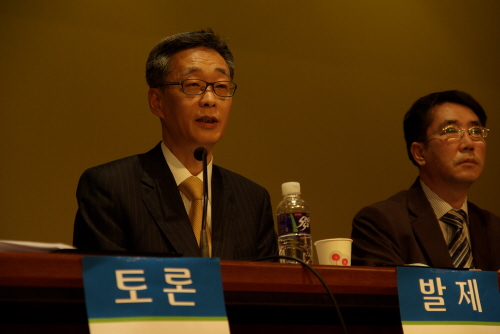
- 종교계 평화 통일 추진 동력 제공해야-민주평통 종교인 포럼
- “평화의 밀물이 밀려옵니다. 갯벌 위에 누워있던 한반도라는 배가 이제 큰 바다를 향해 몸을 일으켰고, 조그만 밀면 나가게 될 것입니다. 우리 종교인들이 해야 할 몫이 바로 배를 미는 동력을 제공하는 것입니다” 한국기독교교회협의회 권오성 총무는 제2차 민주평통 종교인포럼에서 과거 평화와 통일의 물꼬를 터왔던 종교계가 앞으로 해야 할 일은, 평화통일을 위한 지속적 동력을 싣는 것이라며 여섯 가지 실천적 과제를 제시했다. 여섯 가지 실천과제는 △평화와 민족통일이 우리 민족 모두에 유리하다는 인식의 전환 △통일국가에 대한 비전 제시 △ 남·북 모두를 "있는 그대로‘ 인정하고 △ 남한 내부에서의 생활 속 평화와 통일에 대한 실천하며 △북에 대한 긴급지원과 함께 사회개발 프로그램에 좀 더 역량을 집중하는 것과 동시에 △종교 단체 내부의 분단 이데올로기를 청산하는 것이라고 말했다. 종교 대결 이데올로기에서 보호소 역할 담당해야 특히 “종단들과 종교인들은 분단 속에서도 상대적으로 자유로운 영역을 가지고 있어야 한다”고 말하며, 거짓 이데올로기를 ‘자기 정체성’이라고 이해하게 만들지 말고, “그 사회의 화해와 통일을 위한 보호소가 되도록 힘써야 한다”고 강조했다. 권 총무는 이 밖에도 제2차 남북회담에서 남한 종교인들이 제시했던 네 가지 사업 △남북 종교인 평회 대회 개최 △평화주간 설정 △종교인 평화선언 △북한의 종교시설의 복원과 신도들의 순례 제안에 대해 밝히며 ‘이 같은 제안은 평화와 통일을 위한 종교인들의 실천적 동력 제공 노력에서 기인한 것’이라고 설명했다. 한편, 권오성 총무의 발제에 앞서 김상근 민주평통 수석부의장이‘2007 남북정상회담의 의미와 성과’에대해 기조강연을 했다. 2차 정상회담 "6.15 성과 선명하게 살렸다" 김 수석부의장은 해외 교회들과 연대했던 80연대를 회상하며 달라진 통일 운동의 지형에 대해 격세지감을 전하기도 했다. 특히 84년 도잔소에서의 에피소드를 전하며 좌중의 폭소를 자아내기도 했다. “84년 종교계 특히 개신교가 도잔소에서 남북의 평화와 통일 문제를 우리 민족끼리 풀자는 노력을 시도했을 때만 해도, 우리 스스로가 통일 운동을 하는 제3세계 사람들을 믿지 못했습니다” “저는 그 때 체코 목사와 방을 함께 섰는데 그가 과연 목사일까 의심을 했었습니다. 혹 이사람 좌경 사상에 물든 가짜 목사가 아닐까 하고요” “과연 주기도문은 욀까? 그래서 몰래 눈을 뜨고 그 사람이 기도는 하지는 주기도문은 외는지 듣기도 했습니다.” 좌중의 분위기를 집중시킨 김상근 수석부의장은 7.4 공동성명 이후 남북기본합의서 채택과 제1차 남북 정상회담 등의 과정을 설명하고 “지금의 남북 평화 무드는 과거의 꾸준한 노력에서부터”라며 “6.15가 남북 평화 통일의 물꼬를 트고 협력의 시대로 이끄는 중요한 계기였다면, 이번 2차 남북회담은 통일의 지향점을 보다 명확하게 했다”고 평가했다. 그는 “이번 합의는 바로 완전한 통일을 이루기 위한 전 단계인 남북연합의 단계로 가는 과정에 있다”며 “6.15의 의미를 더욱 선명하게 살린 중요한 의미를 갖는다”고 부연했다.
2007-10-30 03:32:26
- 2007 Declaration of the Summit
- Declaration on the Advancement of South-North Korean Relations, Peace and Prosperity In accordance with the agreement between President Roh Moo-hyun of the Republic of Korea and Chairman Kim Jong Il of the National Defense Commission of the Democratic People’s Republic of Korea, President Roh visited Pyongyang from October 2-4, 2007. During the visit, there were historic meetings and discussions. At the meetings and talks, the two sides have reaffirmed the spirit of the June 15 Joint Declaration and had frank discussions on various issues related to realizing the advancement of South-North relations, peace on the Korean Peninsula, common prosperity of the Korean people and unification of Korea. Expressing confidence that they can forge a new era of national prosperity and unification on their own initiative if they combine their will and capabilities, the two sides declare as follows, in order to expand and advance South-North relations based on the June 15 Joint Declaration: 1. The South and the North shall uphold and endeavor actively to realize the June 15 Declaration. The South and the North have agreed to resolve the issue of unification on their own initiative and according to the spirit of “by-the-Korean-people-themselves.” The South and the North will work out ways to commemorate the June 15 anniversary of the announcement of the South-North Joint Declaration to reflect the common will to faithfully carry it out. 2. The South and the North have agreed to firmly transform inter-Korean relations into ties of mutual respect and trust, transcending the differences in ideology and systems. The South and the North have agreed not to interfere in the internal affairs of the other and agreed to resolve inter-Korean issues in the spirit of reconciliation, cooperation and reunification. The South and the North have agreed to overhaul their respective legislative and institutional apparatuses in a bid to develop inter-Korean relations in a reunification-oriented direction. The South and the North have agreed to proactively pursue dialogue and contacts in various areas, including the legislatures of the two Koreas, in order to resolve matters concerning the expansion and advancement of inter-Korean relations in a way that meets the aspirations of the entire Korean people. 3. The South and the North have agreed to closely work together to put an end to military hostilities, mitigate tensions and guarantee peace on the Korean Peninsula. The South and the North have agreed not to antagonize each other, reduce military tension, and resolve issues in dispute through dialogue and negotiation. The South and the North have agreed to oppose war on the Korean Peninsula and to adhere strictly to their obligation to nonaggression. The South and the North have agreed to hold talks between the South’s Minister of Defense and the North’s Minister of the People’s Armed Forces in Pyongyang in November to discuss ways of designating a joint fishing area in the West Sea to avoid accidental clashes and turning it into a peace area and also to discuss measures to build military confidence, including security guarantees for various cooperative projects. 4. The South and the North both recognize the need to end the current armistice regime and build a permanent peace regime. The South and the North have also agreed to work together to advance the matter of having the leaders of the three or four parties directly concerned to convene on the Peninsula and declare an end to the war. With regard to the nuclear issue on the Korean Peninsula, the South and the North have agreed to work together to implement smoothly the September 19, 2005 Joint Statement and the February 13, 2007 Agreement achieved at the Six-Party Talks. 5. The South and the North have agreed to facilitate, expand, and further develop inter-Korean economic cooperation projects on a continual basis for balanced economic development and co-prosperity on the Korean Peninsula in accordance with the principles of common interests, co-prosperity and mutual aid. The South and the North reached an agreement on promoting economic cooperation, including investments, pushing forward with the building of infrastructure and the development of natural resources. Given the special nature of inter-Korean cooperative projects, the South and the North have agreed to grant preferential conditions and benefits to those projects. The South and the North have agreed to create a “special peace and cooperation zone in the West Sea” encompassing Haeju and vicinity in a bid to proactively push ahead with the creation of a joint fishing zone and maritime peace zone, establishment of a special economic zone, utilization of Haeju harbor, passage of civilian vessels via direct routes in Haeju and the joint use of the Han River estuary. The South and the North have agreed to complete the first-phase construction of the Gaeseong Industrial Complex at an early date and embark on the second-stage development project. The South and the North have agreed to open freight rail services between Munsan and Bongdong and promptly complete various institutional measures, including those related to passage, communication, and customs clearance procedures. The South and the North have agreed to discuss repairs of the Gaeseong-Sinuiju railroad and the Gaeseong-Pyongyang expressway for their joint use. The South and the North have agreed to establish cooperative complexes for shipbuilding in Anbyeon and Nampo, while continuing cooperative projects in various areas such as agriculture, health and medical services and environmental protection. The South and the North have agreed to upgrade the status of the existing Inter-Korean Economic Cooperation Promotion Committee to a Joint Committee for Inter-Korean Economic Cooperation to be headed by deputy prime minister-level officials. 6. The South and the North have agreed to boost exchanges and cooperation in the social areas covering history, language, education, science and technology, culture and arts, and sports to highlight the long history and excellent culture of the Korean people. The South and the North have agreed to carry out tours to Mt. Baekdu and open nonstop flight services between Seoul and Mt. Baekdu for this purpose. The South and the North have agreed to send a joint cheering squad from both sides to the 2008 Beijing Olympic Games. The squad will use the Gyeongui Railway Line for the first-ever joint Olympic cheering. 7. The South and the North have agreed to actively promote humanitarian cooperation projects. The South and the North have agreed to expand reunion of separated family members and their relatives and promote exchanges of video messages. To this end, the South and the North have agreed to station resident representatives from each side at the reunion center at Mt. Geumgang when it is completed and regularize reunions of separated family members and their relatives. The South and the North have agreed to actively cooperate in case of emergencies, including natural disasters, according to the principles of fraternal love, humanitarianism and mutual assistance. 8. The South and the North have agreed to increase cooperation to promote the interests of the Korean people and the rights and interests of overseas Koreans on the international stage. o The South and the North have agreed to hold inter-Korean prime ministers’ talks for the implementation of this Declaration and have agreed to hold the first round of meetings in November 2007 in Seoul. o The South and the North have agreed that their highest authorities will meet frequently for the advancement of relations between the two sides. Oct. 4, 2007 Pyongyang Roh Moo-hyun President Republic of Korea Kim Jong Il Chairman, National Defense Commission Democratic People’s Republic of Korea
2007-10-30 07:37:01
2007-10-30 03:29:42
2007-09-18 05:23:12
- 대체복무 허용 정부 결정에 대한 한국교회 입장
- 한국기독교교회협의회 정의평화위원회는 정부 당국이 오늘 종교적 사유 등으로 집총 기피등 병역 거부자에게 병역이행 대신 대체복무를 허용한 것을 적극 환영한다. 우리는 지난 2001년부터 양심에 따른 병역 거부자 문제가 사회적 쟁점이 되었을 때, 소수자 인권과 비폭력 평화의 관점에서 정부 당국에게 양심에 따른 병역거부를 인정하고 대체복무제 도입을 촉구해 왔다. 지난 반세기 이상 종교적 양심에 따른 집총 및 군사훈련 거부로 인해 1만여 명의 젊은이들이 구속되어 전과자가 되었으며, 최근에도 1년에 700여명이 실형선고를 받고 있는 상황이다. 2000년에 한국정부는 양심에 따른 병역거부 인정과 결의안 채택을 요구한 유엔의 국제인권 시민∙ 정치적 권리규약을 결의했고, 국가인권위원회 또한 2005년 12월에 ‘양심의 자유’ 보호 차원에서 관계 부처에 대체복무제를 권고하기도 했다. 최근에는 종교뿐 아니라 비폭력 평화, 인간존엄에 대한 강한 신념에 따른 병역 거부자가 늘어나고 있기도 하다. 이런 현실 속에서 오늘 정부 당국의 종교 등의 사유로 인한 병역거부자에게 대체복무를 인정한 것은 우리나라가 인권 선진국으로 나아가는 또 하나의 계기라고 본다. 국가 안보를 결코 간과할 수 없지만, 향후 우리 사회는 민중 안보가 보다 중요하게 대두될 것이라 확신하기에, 정부 당국은 대체복무제의 다변화를 통한 복지사회국가를 지향함으로써 민간 안전망 구축을 위한 인권옹호에 더욱 매진해 주기를 바란다. 2007.9.18 한국기독교교회협의회 총 무 권 오 성 정의평화위원장 유 원 규