KNCC

- (보도) ‘미 · 일 방위협력지침’ 개정을 폐지하라
- 남북(북남)교회 공동성명서 한(조선)반도와 세계 평화를 위협하는 ‘미 · 일 방위협력지침’ 개정을 폐지하라! “그가 많은 민족 중에 심판하시며 먼 곳 강한 이방을 판결하시리니 무리가 그 칼을 쳐서 보습을 만들고 창을 쳐서 낫을 만들 것이며 이 나라와 저 나라가 다시는 칼을 들고 서로 치지 아니하며 다시는 전쟁을 연습하지 아니하리라”(미가 4장 3절) 2015년 4월 29일 오바마 미국 대통령과 아베 일본 총리가 백악관에서 정상회담을 열고 한(조선)반도를 포함한 전 세계를 일본 자위대의 작전 범위로 삼는 ‘미 · 일 방위협력 지침’ 개정에 합의했다. 이번 개정안은 제2차 세계대전의 전범국인 일본의 군사력 증강에 날개를 달아주고 그것을 미국의 군사패권 강화에 활용하겠다는 것으로 우리는 실로 경악을 금할 수 없다. 위 워싱턴 정상회담에서 미국정부는 ‘미·일 방위협력 지침’ 개정뿐만 아니라 전범국인 일본의 유엔안보리 상임이사국 진출까지 지지하기로 결정했다. 이는 일본이 저지른 침략전쟁, ‘위안부’ 동원, 남경대학살 등 전쟁범죄에 대한 미국의 면죄부이다. 이번 미일 협약은 특히 일제 강점기를 지내온 한(조선)국민과 전체 아시아인들에 대한 모독임에 틀림없다. 특별히 일본은 침략전쟁에 대한 어떠한 역사적 책임도지지 않는 상황이기에 더욱 분노를 금할 길이 없다. 더욱이 이번 ‘미·일 방위협력 지침’ 개정은 분단 상황에 놓인 한(조선)반도에는 커다란 재앙이 아닐 수 없다. 이번 개정안을 토대로 미국이 유사시로 판단하여 일본의 한(조선)반도 상륙을 용인한다면 한반도의 평화통일은 더욱 어려워 질 것이고 남과 북(북과 남)은 극도의 불안한 상태가 지속될 것이다. 또한 이번 미·일 방위협력1) 강화는 일본의 전수방위 정책이 무력화 되고 그로 인해 한(조선)반도를 포함한 동아시아 전역에 심각한 군비경쟁이 초래될 것이다. 이는 역내 전반의 군사적 긴장을 고조시키는 결과를 낳게 될 것이며 역내 인적, 경제적 상호의존을 위협할 우려가 높다. 1) 일본 방위백서에 규정된 대로 방어를 위주로 하는 일본의 군사정책을 일컫는다. “일본은 상대로부터 무력공격을 받았을 때 비로소 방위력을 행사하고, 그 방위력 행사의 양태도 자위를 위해 필요한 최저한도에 머물게 하며, 보유하는 방위력도 자위를 위해 필요한 최저한도의 것으로 한정 한다” [방위백서] 이에 세계평화를 갈망하는 여론을 담아 우리는 한(조선)반도와 동아시아, 나아가 세계 평화를 위협하는 미국과 일본의 이번 개정안을 우려하며 다음과 같이 우리의 입장을 밝힌다. 1. 아시아를 넘어 세계 평화를 위협하는 ‘미·일 방위협력지침’ 개정을 즉각 폐지하라. 2. 미국정부는 군사패권 욕망을 버리고 대화와 협력의 평화적 외교로 전환하라. 3. 일본정부는 전쟁범죄에 대해 세계 앞에 사죄하고 평화헌법을 준수하고 군사 대국화 야욕을 중단하라. 4. 남북(북남)의 그리스도인들은 한(조선)반도와 동아시아, 세계평화를 지켜나가기 위해 세계교회와 평화를 갈망하는 전 세계 양심세력과 연대하여 기도하고 행동할 것이다. 2015년 6월 8일 한국기독교교회협의회 조선그리스도교련맹 중앙위원회
- (보도) 미국대사 피습사건과 관련한 현 시국을 염려하며
- 현 시국을 염려하며 김기종 씨의 미국대사 피습사건은 성숙한 민주주의와 평화를 바라는 모든 국민들에게 큰 충격을 주었습니다. 본회는 이 사건에 대해 큰 유감을 표명하며 리퍼트 대사의 빠른 쾌유를 빕니다. 1. 본회는 폭력행위를 통한 의사표현을 반대합니다. 평화를 말하면서 물리적 폭력을 행사하는 것은 모순입니다. 2. 본회는 개인에 의한 우발적인 범행을 이유로 통일운동과 민주화운동에 헌신하는 분들과 본회 관련 성직자, 평신도들에 대한 연계 수사에 대해 심히 염려하지 않을 수 없습니다. 정부 당국은 국민들이 납득하는 상식적인 수준에서 사건 조사를 종결하고 더 이상 확대시키지 말아야 합니다. 3. 본회는 이번 사건을 계기로 정치권이 북한인권법, 테러방지법, 사드 배치 등 중요한 대북, 안보 현안들을 국민들의 충분한 동의 없이 서둘러 처리하는 우를 범하지 않기를 바랍니다. 4. 본회는 이 사건으로 민족의 화해와 평화통일을 위한 노력이 위축되지 않기를 바라며, 앞으로의 상황을 예의주시 할 것입니다. 2015년 3월 11일 한국기독교교회협의회 총 무 김 영 주
- (성명) 아베 정권은 집단자위권 법제화 즉각 중단하고 평화헌법 9조 정신 수호하라!
- 아베 정권은 집단자위권 법제화 즉각 중단하고 평화헌법 9조 정신 수호하라! “① 일본국민은 정의와 질서를 기조로 하는 국제 평화를 성실히 희구하고, 국권의 발동에 의거한 전쟁 및 무력에 의한 위협 또는 무력의 행사는 국제분쟁을 해결하는 수단으로서는 영구히 이를 포기한다. ② 전항의 목적을 성취하기 위하여 육해공군 및 그 이외의 어떠한 전력도 보유하지 않는다. 국가의 교전권 역시 인정치 않는다.” (일본평화헌법 제 2장 전쟁의 포기 제 9조) 집단적 자위권 행사와 관련된 안보법안들이 어제 일본 중의원에서 야당이 퇴진한 가운데 날치기 통과되었다. 일본 헌법학자 90%가 위헌이라고 지적하였고 야당, 시민단체와 대부분의 국민들이 거세게 저항하였음에도 불구하고 아베정권은 ‘교전권을 인정하고 일본을 보통국가로 전환’하는 집단적 자위권 (일본의 동맹국이나 주변국이 공격받았을 경우 일본이 공격 받은 것으로 간주해 적을 공격할 수 있는 권리)의 법제화를 강행하고 있다. 지난 2007년부터 줄 곧 평화헌법 9조를 지키기 위하여 전 세계 종교인들과 시민사회와 연대해 온 본회는 금번 집단자위권 법제화 강행 처리는 민의를 무시하고 민주적 합의 과정을 말살하는 등 그 절차에 심각한 오류가 있었으며 내용상으로도 헌법 9조의 정신에 반하는 것임을 명백히 밝혀 둔다. 아울러 집단적 자위권 행사는 동북아지역의 과도한 군비경쟁을 촉발하여 이 지역의 평화정착과 민중의 안보에 심대한 위협이 될 것임을 경고하면서 일본/미국/한국 정부에 아래와 같이 촉구한다. 1. 아베 정부는 일본평화헌법 9조 정신에 위배되는 집단자위권 법제화의 강행폭주를 즉각 중단하라! 무력행사를 통하여 자국의 안보를 유지하겠다는 폭력적 발상을 포기하고 ‘대화와 협력’, ‘공존과 번영’의 적극적 평화 정책으로 전환하여 동북아의 평화와 안정에 기여하기를 촉구한다. 2. 미국 정부는 자국의 군사적 패권 유지를 위하여 일본을 방패막이로 이용하는 행위를 즉각 중단하라! 이를 위하여 우선적으로 지난 4월 집단적 자위권 행사가 가능하도록 개정된 ‘미일방위협력지침’을 철회하여야 한다. 미국은 일본이 동북아 지역의 참다운 평화수호자로 올바로 설 수 있도록 다각적으로 지원하여야 하며, 이것이 바로 참다운 동맹국의 도리이다. 3. 한국정부는 아베정부의 극단적 우경화와 신군국주의로의 회귀를 막기 위하여 모든 외교적 노력을 다하기를 촉구한다! 한국정부는 집단적 자위권을 빌미로 언제든 한반도가 일본의 공격 대상이 될 수 있으며 식민지배의 악몽이 재현될 수 있다는 위기인식을 가지고 적극적으로 대일본외교에 나서기를 바란다. 식민지배와 전쟁범죄에 대한 철저한 회개와 배상을 촉구하는 한 편, 일본을 동북아평화정착을 위한 동반자로 여기고 한/일이 함께 지역평화를 위한 대안과 비전을 제시하는 일에 최선을 다하기를 바란다. 2015년 7월 17일 한국기독교교회협의회 총 무 김 영 주
- ‘아베정권의 집단자위권 법제화 날치기 강행 처리에 대한 성명’ 보도요청
- 보 도 자 료 교회협 언론 2015-90호 (2015. 7. 17) 수 신 : 각 언론사 발 신 : 한국기독교교회협의회(NCCK) 제 목 : ‘아베정권의 집단자위권 법제화 날치기 강행 처리에 대한 성명’ 보도요청의 건 아베 정권은 집단자위권 법제화 즉각 중단하고 평화헌법 9조 정신 수호하라! 한국기독교교회협의회(NCCK, 총무 김영주 목사)는 17일 긴급하게 아베정권의 집단자위권 법제화 날치기 강행처리에 대하여 강력하게 규탄하는 성명을 발표하였다. NCCK는 성명에서 이번 아베정권의 날치기 강행처리는 “민의를 무시하고 민주적 합의 과정을 말살하는 등 그 절차에 심각한 오류가 있었으며 내용상으로도 헌법 9조의 정신에 반하는 것임을 명백히 밝혀 둔다.”며 “아울러 집단적 자위권 행사는 동북아지역의 과도한 군비경쟁을 촉발하여 이 지역의 평화정착과 민중의 안보에 심대한 위협이 될 것임을 경고”했다. 이어서 NCCK는 일본/미국/한국 정부에 “1. 아베 정부는 일본평화헌법 9조 정신에 위배되는 집단자위권 법제화의 강행폭주를 즉각 중단할 것 2. 미국 정부는 자국의 군사적 패권 유지를 위하여 일본을 방패막이로 이용하는 행위를 즉각 중단할 것 3. 한국정부는 아베정부의 극단적 우경화와 신군국주의로의 회귀를 막기 위하여 모든 외교적 노력을 다할 것”을 촉구했다. NCCK는 지난 2007년부터 줄 곧 평화헌법 9조를 지키기 위하여 전 세계 종교인들과 시민사회와 연대해 온 “평화헌법 9조 수호 종교인 연대”에서 주축으로 활동하여 왔다. 아 래 - 아베 정권은 집단자위권 법제화 즉각 중단하고 평화헌법 9조 정신 수호하라! “① 일본국민은 정의와 질서를 기조로 하는 국제 평화를 성실히 희구하고, 국권의 발동에 의거한 전쟁 및 무력에 의한 위협 또는 무력의 행사는 국제분쟁을 해결하는 수단으로서는 영구히 이를 포기한다. ② 전항의 목적을 성취하기 위하여 육해공군 및 그 이외의 어떠한 전력도 보유하지 않는다. 국가의 교전권 역시 인정치 않는다.” (일본평화헌법 제 2장 전쟁의 포기 제 9조) 집단적 자위권 행사와 관련된 안보법안들이 어제 일본 중의원에서 야당이 퇴진한 가운데 날치기 통과되었다. 일본 헌법학자 90%가 위헌이라고 지적하였고 야당, 시민단체와 대부분의 국민들이 거세게 저항하였음에도 불구하고 아베정권은 ‘교전권을 인정하고 일본을 보통국가로 전환’하는 집단적 자위권 (일본의 동맹국이나 주변국이 공격받았을 경우 일본이 공격 받은 것으로 간주해 적을 공격할 수 있는 권리)의 법제화를 강행하고 있다. 지난 2007년부터 줄 곧 평화헌법 9조를 지키기 위하여 전 세계 종교인들과 시민사회와 연대해 온 본회는 금번 집단자위권 법제화 강행 처리는 민의를 무시하고 민주적 합의 과정을 말살하는 등 그 절차에 심각한 오류가 있었으며 내용상으로도 헌법 9조의 정신에 반하는 것임을 명백히 밝혀 둔다. 아울러 집단적 자위권 행사는 동북아지역의 과도한 군비경쟁을 촉발하여 이 지역의 평화정착과 민중의 안보에 심대한 위협이 될 것임을 경고하면서 일본/미국/한국 정부에 아래와 같이 촉구한다. 1. 아베 정부는 일본평화헌법 9조 정신에 위배되는 집단자위권 법제화의 강행폭주를 즉각 중단하라! 무력행사를 통하여 자국의 안보를 유지하겠다는 폭력적 발상을 포기하고 ‘대화와 협력’, ‘공존과 번영’의 적극적 평화 정책으로 전환하여 동북아의 평화와 안정에 기여하기를 촉구한다. 2. 미국 정부는 자국의 군사적 패권 유지를 위하여 일본을 방패막이로 이용하는 행위를 즉각 중단하라! 이를 위하여 우선적으로 지난 4월 집단적 자위권 행사가 가능하도록 개정된 ‘미일방위협력지침’을 철회하여야 한다. 미국은 일본이 동북아 지역의 참다운 평화수호자로 올바로 설 수 있도록 다각적으로 지원하여야 하며, 이것이 바로 참다운 동맹국의 도리이다. 3. 한국정부는 아베정부의 극단적 우경화와 신군국주의로의 회귀를 막기 위하여 모든 외교적 노력을 다하기를 촉구한다! 한국정부는 집단적 자위권을 빌미로 언제든 한반도가 일본의 공격 대상이 될 수 있으며 식민지배의 악몽이 재현될 수 있다는 위기인식을 가지고 적극적으로 대일본외교에 나서기를 바란다. 식민지배와 전쟁범죄에 대한 철저한 회개와 배상을 촉구하는 한 편, 일본을 동북아평화정착을 위한 동반자로 여기고 한/일이 함께 지역평화를 위한 대안과 비전을 제시하는 일에 최선을 다하기를 바란다. 2015년 7월 17일 한국기독교교회협의회 총 무 김 영 주 문의: NCCK 홍보실 강석훈 목사(02-742-8981 / 010-2766-6246) The National Council of Churches in Korea (NCCK) Tel. 02-742-8981 Fax. 02-744-1689 Email. kncc@kncc.or.kr http://www.kncc.or.kr
- 2015년 4월 주요일정
- NCCK 2015년 4월 주요일정 2일(목) 세족목요일 도보순례와 기도회(세족식) 일시: 4월 2일(목) 오후 2시, 우호 5시 장소: 팽목항 담당: 일치협력국 3일(금) 성금요일 선상, 팽목항 예배 일시: 4월 3일(금) 오전 9시 30분 장소: 맹골수도, 팽목항 담당: 일치협력국 5일(일) 부활절 새벽예배 일시: 4월 5일(일) 오전 5시 장소: 중앙루터교회 담당: 일치협력국 7일(화) 탈핵학교 수료식 일시: 4월 7일(화) 오후 7시 장소: 기독교회관 709호 담당: 생명·윤리위원회 9일(목) 에큐메니칼 선교정책 협의회 일시: 4월 9일(목) 오전 9시 장소: 창천감리교회 담당: 총무국 12일(일) 장애인주일 연합예배 일시: 4월 12일(일) 오후 2시 장소: 서울농아감리교회 담당: 정의평화위원회 17일(금) 언론위 3차회의 일시: 4월 17일(금) 오후 2시 장소: 기독교회관 709호 담당: 언론위원회 23일(목) 제63-2차 정기실행위원회 일시: 4월 23일(목) 오후 2시 장소: 기독교회관 2층 조에홀 담당: 총무국
- NUCLEAR-Free SCHOOL
- td,th { word-break:break-word !important; word-break:keep-all !important; } The 10-week academy which has been run by the Life and Ethics Committee of the NCCK, is just being completed. The sessions ran every Tuesday for 10 weeks from Jan. 27 until March 31, with wrap up and graduation taking place on Saturday, April 11. Every week, around 15 people have attended this academy. In this school, the participants learned about nuclear problem in terms of not only environment and health, but also of human right, ethics, peace, economy and policy. The participants are expected to share their growing awareness of the dangers of nuclear energy and need of renewable energy. The fourth lecture especially dealt with nuclear energy from the Christian’s view and looked into the Korean Christians’ activities for the post-nuclear world and also the Statement of WCC “Towards a Nuclear-free World”. The topics dealt with in each session are as follows: 1. Ethics and Logic of Post-Nuclear by Kim Jeong Chul, the Publisher of Green Critics 2. Taiwanese Post Nuclear Activity, a public lecture given at the National Assembly by Hung Sun-han, Vice General Secretary of Green Citizen’s Actions Alliance of Taiwan. 3. The Reality and Prevention of Medical Radiation Exposure, low dose radioactivity and its effect on the body, lecture given by Professor Ju Young Su, a Medical doctor. 4. The Post-Nuclear world in the perspective of Christianity , presented by Rev. Ahn Hong Taek, the Chairperson of the Church Committee, Korean Christian Solidarity on a World without Nuclear. 5. Nuclear Energy and Radiation – a basic introduction, by Choi Mu Young, professor at Seoul National University. 6. Nuclear Power Plant History and how to break our reliance to Nuclear Power Plants – Nuclear and alternatives, given by Yoon Sun Jin, professor at Graduated School of Environmental Studies, Seoul University. 7. “Those who have been Erased”, a historical perspective and reality of the Korean atomic victims living in Japan when the atomic bombs were dropped, given by Professor Han Hong Ku, Seongkonghoe Univertity 8. Local and Community Energy Policies and Self Sufficiency, by Mr. Lee Yoon Jin, the Green Party 9. Overseas cases and lessons on Nuclear waste and spent fuel. Reprocessing facilities and public opinion, by Professor Lee Young Hee, Catholic University 10. Post-Nuclear and Green Energy in the Climate Change Era, delivery by Professor Kim Jeong Yook, Co-representative of Korean Christian Association for Environmental Movement
- Second Homeless People’s Creative Music Festival : Like Jesus, our lives are renewed
- td,th { word-break:break-word !important; word-break:keep-all !important; } Culture fundraising concert - “Our Brothers of the Streets Sing a Song of Hope” This event, a continuing project of the NCCK Committee against Homelessness, was held on March 30 at the Cafe “Mun-hwa Gong-gan” where the homeless have work as baristas , read books and study computers for rehabilitation. A video ceremony was contributed by director Kim Kyung Mo who participated as an assistant director for The Host, 2006 (http://movie.naver.com/movie/bi/mi/basic.nhn?code=39841). He will go on to film a documentary of the homeless and volunteers making preparations for the Homeless Creative Music Festival. In this way we can widen the audience who experiences the emotional impact of the event for the homeless and volunteers. Lee Jae Young who played the danso, a short bamboo flute, had been homeless before participating in the first Homeless People’s Creative Music Festival. After that event, he determined not to live like this. He returned to his hometown, and worked as a taxi driver. Receiving the news of the preparation of the second festival fundraising concert, he came at his own expense to Seoul from Jinjoo. He wants to declare how important this festival is. Through it, he received friends, hope and will to succeed, and this festival process is able to provide participants with restored relations and renewed lives. Cha Bit Na is a singer song-writer; Mido is an indie band organized by Jeon yeong-hoon who is a minister and a CCM singer song-writer; Sol-sol-boo-neun Bom-baram (The Gentle Spring Breeze) is also an indie band. They all contributed their talent for this concert. Talk concert reflections were given by Ko Eun Jeong, Jeong Yoo Cheol, and Park Chang Yoon Ko Eun Jeong is a volunteer who is also a music teacher and musical actor, while Jeong Yoo Cheol, and Park Chang Yoon are homeless men. Jeong Yoo Cheol participated in the first festival, taking an active part as a creative musical actor and choir member. He wanted to express the valuable advantage this festival has for participants. Park Chang Yoon did not participate in the first festival, but after hearing of its advantage from homeless friend who was very impressed by its significance, he wanted to participate in this one. The goals of the program were presented this way: This event is a stage in which homeless people and non-homeless are, through the medium of music, gladly accepting their differences and working together. It is a program of knowing, understanding and appreciating each other through the breaking of our biases. Our small effort will be for them a big support. The street dads are standing against the bias and preconceptions held about homeless people! At the Homeless People’s Creative Music Festival they have the opportunity to tell their own stories and share their feelings. This will be a place of communicating with the people who are empowering the process as sponsors or participants, and through this communicating, we are going to make the Second Homeless People’s Creative Music Festival.
- 2015 Easter South- North Joint Prayer
- Warm greetings from the NCCK. On March 23 the Korean Christian Federation and the National Council of Churches in Korea jointly issued “2015 Easter North-South Joint Prayer.” Every year since 1996 the Easter joint prayer has been jointly worked out by the KCF in North and the NCCK in South. I would like to ask you to widely distribute this Prayer through your network. Kim Young Ju td,th { word-break:break-word !important; word-break:keep-all !important; } 70 years since the joys of incomplete independence were reduced to the pains of separation On this morning when we reminisce of the jubilance of resurrection The voice of forgiveness and reconciliation resonates in our hearts 70 years, but still a broken culture rages among us In the face of the rule of the dead powers of the military industry We repent for our feeble faith that confessed words instead of actions We see ourselves frightened to meet even before considering forgiveness Such is rooted in our distrust We confess that no love and faith for each other had ever existed No blame was put upon the crowd that cried for the cross Following Jesus who has revealed the path of salvation through forgiveness, After 70 years of separation, we pray that the fire of forgiveness and reconciliation kindle in every nation of the world Lord, lead our way Before we fault others, Help us purify ourselves, as we are filled with hate, anger and violence Grant us the inner courage to reflect back on our true past Face the hidden truth And reunite with those who suffered unrighteous death Give our weak selves the Holy Spirit Let us not give up on our pursuit for forgiveness, reconciliation and unification Amidst the despairs of death, you have shown us great hope through resurrection Bring the new life of resurrection to this dying land In the same way that Jacob, after crossing the Jabok River embraced Esau and danced, Armed with forgiveness, let us cross the river of hate and enmity to unite, North and South Wash away the agonies of separation To give our sons and daughters one, living nation We believe that the road of this journey would save people and give hope to mankind In the name of Jesus Christ who never ceases to call Into the world of resurrection, We pray sincerely, Amen. National Council of Churches in Korea (NCCK) Korean Christian Federation (KCF)
- Communication Committee
- td,th { word-break:break-word !important; word-break:keep-all !important; } There are many problems with today’s Korea. The government, using the National Security Law as rationale, tramples on the human rights of Koreans. At the same time, the major media outlets are not independent, and do not objectively report on the actions of the government. For several months now, the NCCK has been organizing a committee to raise this situation and think of ways to reform the law and the media-government relationship. The NCCK began this with a realization of the prophetic responsibility of the Christian community to raise this issue for the health of the society. A committee called the Communication Committee has been brought together. About 30 people representing communication professors, human rights lawyers, independent media people, as well as Church representatives specializing in this topic came together on March 26 for the first discussion of the issue of freedom of speech and the press. There were a lot of stories of excesses by the government trying to muzzle independent criticism of their policies. For instance a university student holding a one-person demonstration denouncing the government was seized by the police. An political caricaturist was asked to ‘correct’ his images. The owner of Media Today who asked pointed questions about the 7 hours around the Sewol sinking, was faced with government investigations.
- A WORLD WITHOUT NUCLEAR POWER
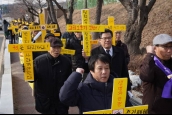
- td,th { word-break:break-word !important; word-break:keep-all !important; } On February 27, a prayer service for a world without nuclear power took place in front of Gori I, the oldest nuclear power plant in Korea. Significantly, it took place just hours after the lifetime of Korea's second oldest reactor, Wolsong, had been extended once more. What has become clear to many Christians during the last 60 years is that nuclear power and energy pose many threats to people and the environment, and these threats include the problems of processing, transport and storage of radioactive nuclear waste, the risk of nuclear weapons proliferation and terrorism, as well as health risks and environmental damage from uranium mining. The ecological impact of nuclear weapons and power generates environmental side effects that are far more devastating than even the disastrous consequences of the initial blast. After all, nuclear energy contributes towards health problems, displacement, pollution and invisible contamination passed on to future generations with incurable pain and suffering. Therefore, we gathered, about 100 people, on that Friday in front of the power plant; sang, prayed, heard voices of local NGOs and Christians, and marched peacefully to the front gate of the plant. The service, entitled ‘Ecumenical Prayer for a nuclear-free world’ – and subtitled, ‘Goodbye to over-aged nuclear plants that have exceeded their life span’, was organized by the PROK ECMC, the Korean Methodist Mission Department, Busan Presbytery, Busan NCC, Busan YMCA and YWCA and sponsored by the NCCK Life and Ethics Committee. The scriptures used to focus worship were Genesis 3:5,6 and Matthew 7:24-29. Background Information about Korea’s nuclear industry The era of nuclear energy production in South Korea started in 1978 with the Gori I reactor. In 1983, 85 and 86 three more reactors followed at the same location, and in 2011/12, the plant was again extended with the two Shin(=new)-Gori reactors. In 2015/16 two more reactors, Shin-Gori 3 and 4, are scheduled to be connected to the grid. About 40 km north of Gori is the site Wolsong. The first reactor there started power generation in 1983 (its term was extended just last week), Shin Wolsong I started operation in 2012, and Shin Wolsong II will follow in 2015. Other locations are Uljin (also on the east coast) and Yeongwang on the west coast of Korea. Busan and Uljin are cities with a total of almost 5 million inhabitants, who thus live in less than a 25 km vicinity of a nuclear power plant. This total of 24 reactors covers about one-third of the Korean electricity consumption. The originally planned expansion to 60% was revised after the triple disaster in Fukushima in Japan and the revelation of a Korean nuclear scandal. In 2012 it was revealed that for about 5,000 components of Korean nuclear power plants (domestic and foreign) safety certificates were falsified. Several reactors had to be disconnected from the grid for safety reasons until the parts had been replaced. Since 1978, there have been a total of nearly 650 nuclear safety related incidents in Korea; Gori 1-4 are responsible for over 40% of the incidents, Gori I alone recorded 20%.
- WOMEN’S CONSULTATION
- td,th { word-break:break-word !important; word-break:keep-all !important; } On March 19, 60 women gathered to discuss the issues of being women members in NCCK. At the 2014 Annual General Assembly, the Gender Equality Committee had, at its request, been renamed, returning to the earlier name of Women’s Committee. The Women’s Committee hosted this consultation, with 20 representatives coming from the church-based women’s organizations that relate to NCCK, including YWCA and Korean Women Theologians. The women who are members of other committees of NCCK also participated. There was sharing of significant parts of the work each group was doing. The YWCA has long been very involved in the anti-Nuclear issues in Korea. On this 70th year of Korean independence the Women Theologians have been concentrating on the Comfort Women issue and the division and Reunification of Korea. There was some discussion on ways to encourage the appointment of women to NCCK. The NCCK actually stipulates that the representatives of member churches should be 30% women and 10% youth, but there are no real efforts by the member churches to reach this target. How will this be overcome? There have been surveys taken of religious trends within Korean society. The general perception is that the Protestant churches have been declining in attendance, but the surprise which comes from the surveys is that it is specifically that women are leaving Protestant churches. How will the Women’s Committee of NCCK address this reality?
- Upcoming international work of the Women’s Committee:
- For many years the women of NCCK and NCC Japan have alternated in hosting a gathering every two years. In recognition of the importance of the Christian presence in issues within Northeast Asia, NCCK and NCCJ are preparing a joint gathering to be held in Jeju Island in Oct., 2015. This will involve a number of departments, like human rights and nuclear issues, but will also provide a location for the women’s event to take place. NCCJ and WCC will be sponsoring a conference in Nov. 2015 on ‘Hate Speech’, rising nationalism and increasing discrimination against vulnerable groups within nations. NCCK will participate in this event. td,th { word-break:break-word !important; word-break:keep-all !important; }
2015-04-10 01:10:30
- SEWOL SYMPOSIUM
- td,th { word-break:break-word !important; word-break:keep-all !important; } On the evening of March 24, NCCK held a symposium called “Korean Churches’ Response to the Sewol Tragedy”. The aim was to find answers of the Korean churches to the pain and suffering of the families. The evening opened with words of greeting and a prayer. It was followed by two presentations of 30 minutes and some personal comments. The programme ended with a discussion of all participants. The first presentation was entitled “Christian value of life and the ethics of remembering ”, presented by Professor Kim Eun Hae of the Presbyterian University and Theological Seminary (PTUS). The second was “The Difficult Truth of the Death of Jesus for Easter Preparation”, and given by Professor Park Chang Hun of Korea Methodist University. Personal responses were given by Huh Hong Han, the father of a still-missing child, Huh Da Youn and other family members who spoke in witness of the missing, and by Rev. Kim Eun Ho, minister of Ansan Hope Church. First Presentation The first presentation was given by Professor KIM Eunhye of the Presbyterian University and Theological Seminary (PTUS) on "Christian value of life and the ethics of remembering": We are in the time of Lent, in which we as Christians remember the suffering of Christ. The (Korean) Church has always been a community of remembering. By celebrating worship, prayer and the praise of our Lord, we commemorate the deceased. Remembering is dangerous for those who fear the truth. If we remember the death of the victims, the perpetrators of their death will be unable to escape the confrontation with accusations and complaints. I want to emphasize that the Korean church, just as the women who witnessed the resurrection of Jesus, has to remain as a witness on the side of those who innocently deceased. The pain of the bereaved families would not be released through forgetting. You need to remember in order to learn how to live with the pain. Therefore, our compassion (with them) is more important than just that we remember. No one can empathize or sympathize with what the families of the victims of the Sewol Disaster suffered when they were forced to witness the death of their beloved ones. Only by remembering do we have a chance to reveal the truth; and only then can such a disaster be prevented in the future. The opposite of history is not mythology, but oblivion. Because history that is forgotten has to repeat itself. Religious communities are communities of memory and remembrance. We as Christians remember Jesus' suffering and thus the suffering of the world. Jesus says: "I am the Way, the Truth and the Life;" his death gives us life in abundance. The resurrection of Jesus reminds us forever of the victory of life over death, because in His resurrection there is a new beginning. The path to the cross means choosing life. If we die with Him, we will also rise with Him. Second Presentation This first input was followed by a presentation by Professor PARK Chang-hyun of the Methodist Theological University (MTU) on "Prepare for the resurrection of Jesus, who died in Maeng-gol-sudo (the actual site of the Sewol Disaster)": We, as church, must seek to save the souls of those who died, locked in the sinking Sewol Ferry, and raise our voice for them and in their place. If the Korean Church is experiencing no change in its theology now, it loses its claim to proclaim the Joy of Easter in the discipleship of Jesus Christ. How should the Korean church be able to share the joy of Jesus' true resurrection at Easter in this country, when the anniversary of the Sewol Disaster is so imminent ? I was aware on April 16th, 2014 immediately after the Sewol Disaster how this accident would change our theology. I lived in Germany for 15 years, a country in which the memory and the regret of the Holocaust during World War 2 are ubiquitous. We know that the Church must weep with those that mourn and we cried with the families of the victims of the Sewol Disaster. But they are still crying. What do we do? Are we ready to cry with them until they are comforted? Or have we only shown our sympathy to the public? Our task is not only to show compassion, but rather to exercise it for the sake of comforting others. Can we celebrate Easter at all? Can we celebrate the resurrection of Jesus in the face of 304 deaths? Do we not need to rethink our theology? How should people in pain and suffering and sorrow understand resurrection? It is our job to explain it to them, because life needs hope. We need to remember and must not be silent. And even if we as churches are the last ones, we (have to) know where our place is in the fellowship of Christ. Jesus' resurrection is a theological mystery, and the victims of the Sewol Disaster will not be resurrected physically. But they will remain alive through a societal change, as "traces of resurrection." Witness of Family Members In response to the presentations, comments were given by some of the parents of still missing students and Pastor Kim Eunho from the Church of Hope in Ansan, the city from which most of the victims came. HUH Heung-hwan, father of the student HUH Dayoon says, "For us, time has ceased since the disaster. There is no way out, no escape. Our family cannot return back to happier times, for our family as it once was, no longer exists. And as if that alone were not bad enough for us, the political situation is unbearable. For example, the President does not keep her word, politicians want to dismiss the sinking of the Sewol Ferry as a simple traffic accident, members of the bereaved families sleep on the streets in order to fight for the elucidation of the disaster, the fact finding investigation has a time frame of not more than 18 months. The government had no intention from the beginning to take responsibility, everything has been passed on to our shoulders. And yet there is nothing we can do as parents. There is so much to do. Still 9 people are missing. We really miss them. We miss our daughter so much." The mother adds a few words, bursting into tears. "My daughter did actually not want to go on this school trip," she says. "I convinced her to spend a good time with her friends. I .... I pray every night for forgiveness ever since. If I only had not ...... then she would ..... ......" Her voice choked with tears. It took several minutes before she is able to continue. "I hate God for that," she sobbed, "I cannot be thankful anymore. We cannot, we must not, we will not stop until our Dayoony is found and come back home. Please, do not say, it's been a year now, let's stop. Do not say, everything was done that could be done, let's stop. Who can even think of just completing things, while there are still people missing who were not able to return into the arms of their families? There can be no closure before the ship is lifted and investigated and all available evidence is analyzed. Please help us. We who are left, we who are merely surviving, please help us to live. I beg you," she looks into the audience, "I hope that you stay at our side and fight with us. Please remain active, please remain. Thank you." The next one who speaks is LEE Geumhee, mother of the student JO Eunhwa. She also cries. "I cannot even imagine how scared my daughter must have been, how much she suffered, the pain she must have endured. I was not with her, do not know her last thoughts and words. I want her back, I want to take her in my arms so much, embrace her, hold her tight. Every day, every minute I am longing for her. I do not know how to live like that. It hurts so much." She is shaken by crying before she can continue. "For weeks we have endured on the sidewalk in front of the President's Palace, lived there. We cannot be quiet, we will not stop to ask for our daughter, just because one year has passed. Eunhwa's little sister shall live in a better world than that in which her sister died." The last comment came from Pastor Kim Eunho from the Church of Hope in Ansan. He says, "As a pastor, but also as a citizen of Ansan, I asked myself after the disaster, what should be done next. We tinkered with yellow ribbons and organized candlelight prayers. I am convinced that we, as churches, have a special responsibility. The pain is particularly close to us here, because it affects people of our city, our neighborhood, our church."
- PRAYER RESOURCES FOR HOLY/PASSION WEEK
- td,th { word-break:break-word !important; word-break:keep-all !important; } The NCCK prepared a prayer resource booklet for its member churches, “You are all Witnesses of these things – Together with the Bereaved Families of the Sewol” for use - with a theme for each day, scripture, quotations from ‘the witnesses’, family members of Sewol victims, a prayer and further prayer requests made. On Monday, the chapter was entitled, “Jesus’ Sufferings Announced”, with scripture John 12:5-8. We pray for revealing the truth about the Sewol Tragedy, and we pray to be able to realize God's will in agony and hardship. Tuesday, under the title ‘The Disciples Betrayal part 1, used the reading Mark 14: 29-31, We pray that the nine missing persons who until now have not been returned to their families may be found as soon as possible, and we pray to be able to consider life more precious than mammon. Wednesday was part 2 of the Disciples’ Betrayal, using the reading of Matthew 26:20-24. We pray for the bereaved families of the Sewol disaster's victims, who are pressed down by the strenuous and exhausting situation, that their wounds may be healed so that they have the strength to get up again, and we pray we will be able to embrace our suffering neighbour by the love that Jesus taught us. On Thursday the theme was Jesus’ Love, with the scripture of John 3:3-ll. We pray to be able to bear the pain of the families that are affected by the Sewol Disaster as our own pain, and we pray to be able to become a reliable neighbour to those ones suffering. The Friday theme was The Death of Jesus, with the reading from Mark 15:34-39. We pray that an agony like this caused by the Sewol Disaster may never happen again, and we pray to become Christians who perform our activities according to what the Bible teaches us. Saturday’s theme was Preparation for Easter, with reading Luke 23:50-56. We pray for lifting of the whole body of the Sewol ferry, and we pray for the fact finding committee to work as quickly as properly to reveal the truth about the disaster.