|
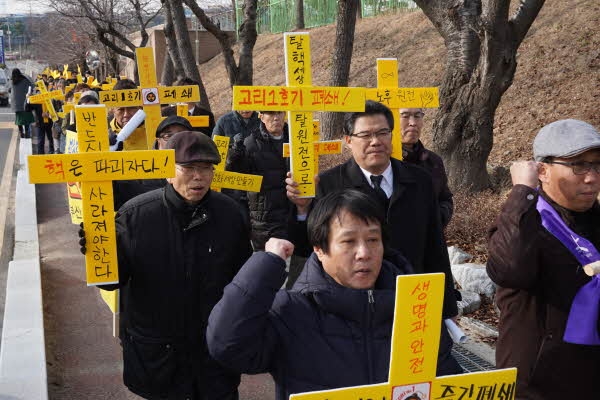
On February 27, a prayer service for a world without nuclear power took place in front of Gori I, the oldest nuclear power plant in Korea. Significantly, it took place just hours after the lifetime of Korea's second oldest reactor, Wolsong, had been extended once more.
What has become clear to many Christians during the last 60 years is that nuclear power and energy pose many threats to people and the environment, and these threats include the problems of processing, transport and storage of radioactive nuclear waste, the risk of nuclear weapons proliferation and terrorism, as well as health risks and environmental damage from uranium mining. The ecological impact of nuclear weapons and power generates environmental side effects that are far more devastating than even the disastrous consequences of the initial blast. After all, nuclear energy contributes towards health problems, displacement, pollution and invisible contamination passed on to future generations with incurable pain and suffering.
Therefore, we gathered, about 100 people, on that Friday in front of the power plant; sang, prayed, heard voices of local NGOs and Christians, and marched peacefully to the front gate of the plant. The service, entitled ‘Ecumenical Prayer for a nuclear-free world’ – and subtitled, ‘Goodbye to over-aged nuclear plants that have exceeded their life span’, was organized by the PROK ECMC, the Korean Methodist Mission Department, Busan Presbytery, Busan NCC, Busan YMCA and YWCA and sponsored by the NCCK Life and Ethics Committee. The scriptures used to focus worship were Genesis 3:5,6 and Matthew 7:24-29.
Background Information about Korea’s nuclear industry
The era of nuclear energy production in South Korea started in 1978 with the Gori I reactor. In 1983, 85 and 86 three more reactors followed at the same location, and in 2011/12, the plant was again extended with the two Shin(=new)-Gori reactors. In 2015/16 two more reactors, Shin-Gori 3 and 4, are scheduled to be connected to the grid.
About 40 km north of Gori is the site Wolsong. The first reactor there started power generation in 1983 (its term was extended just last week), Shin Wolsong I started operation in 2012, and Shin Wolsong II will follow in 2015. Other locations are Uljin (also on the east coast) and Yeongwang on the west coast of Korea. Busan and Uljin are cities with a total of almost 5 million inhabitants, who thus live in less than a 25 km vicinity of a nuclear power plant.
This total of 24 reactors covers about one-third of the Korean electricity consumption. The originally planned expansion to 60% was revised after the triple disaster in Fukushima in Japan and the revelation of a Korean nuclear scandal. In 2012 it was revealed that for about 5,000 components of Korean nuclear power plants (domestic and foreign) safety certificates were falsified. Several reactors had to be disconnected from the grid for safety reasons until the parts had been replaced. Since 1978, there have been a total of nearly 650 nuclear safety related incidents in Korea; Gori 1-4 are responsible for over 40% of the incidents, Gori I alone recorded 20%.
|