THE STATE OF THE MEDIA IN TODAY’S KOREA
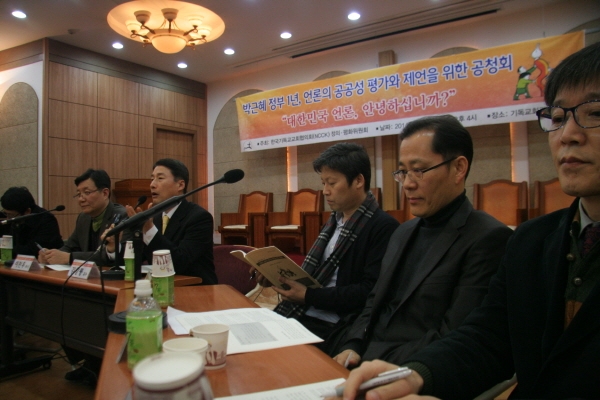
On Feb. 11, an event was hosted by the Justice and Peace Department of NCCK on the situation of the Korean mass media at this point in the Park Geun Hye government. There are very great concerns about freedom of speech and freedom of the press violations carried out as government policy for controlling public awareness.
Professor Kim Chan Ryoung, professor of Journalism and Mass Communication at Injae University was keynote speaker, and he covered 6 topics in his presentation:
1. What is the meaning of the manipulation of public opinion by government?
2. Is it possible for public broadcasting systems to restore their public confidence?
3. What is the point of the controversy over partisanship at the Korean Communications Standards Commission?
4. What is the correlation between the increase of public broadcasting fees and the private ‘channels of comprehensive programming’?
5. How far will we tolerate unfair reporting from the ‘channels of comprehensive programming’?
6. How should we consider the strike of journalists in significant for public confidence of the press?
Some of what he was saying was that the media editorial policy is directly controlled by government, so that no objective reporting is taking place. While during the election campaign President Park Geun Hye promised change to the governance structure of the Broadcasting systems, she has done nothing; in fact just the opposite is happening. The government is appointing high level personnel, even in public broadcasting entities, and it is highly frustrating to ethical journalists, who have staged strikes in opposition to the policy, and have been suffering from firing and disciplinary action for accurate and ethical reporting.
The official government line which the media is being complicit in and carrying out is constant falsification of former presidents Kim Dae Jung and Roh Moo Hyun, who are being continually described in what Professor Kim calls a hate campaign. Such constant repetition, even of wrong information, leads to the people beginning to believe it.
Prof. Kim also talked about the now-familiar issue of National Investigative Service fraudulent intervention in the election, by systematic manipulation of public opinion mainly through the social media (Facebook and Twitter), and said the Korean society cannot afford to ignore this.
The church’s role is to encourage people to know what is happening behind the media reports, to speak out in the public spaces (Internet, Facebook, Twitter), and to support alternative media begun by those journalists who have been fired from major news providers.
There must be a real social movement for media democratization or future generations will receive a damaged society which lacks freedom of speech and expression.
The NCCK Justice and Peace Department will work toward this movement, continuing to raise a prophetic voice toward the South Korean situation.
|