|
REMEMBERING A MARTYR OF DEMOCRACY
Democracy came to South Korea in 1987, after many years of peoples’ struggle
against dictatorship. It is important to remember that struggle, and how the rights
have been achieved at great cost.
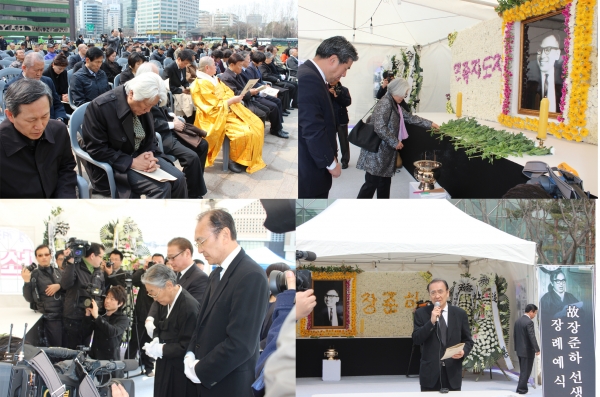
On Maundy Thursday, March 28, special memorial services were held for the important
journalist and activist for democracy, Jang JunHa, who had died in 1975, as he played a
leadership role in the actions against dictator Park Chung Hee. Two days before, on March
26, 2013, the results of a forensic investigation into the death of Jang, had declared him the
victim of homicide.
Jang had been a leading character in the resistance to the dictatorial Yushin Constitution,
which was brought into effect under President Park in 1972. He was winner of the
prestigious Magsaysay Award for Literature. He was imprisoned 9 times under Park’s
regime, released for the last time in Dec., 1974. In 1975 his body was found dead near a
mountain outside Seoul. The government ruled his death the result of a mountain-climbing
accident.
However, in August last year, Jang’s remains were relocated, and were seen for the first
time in 37 years. At that time, it was noted that there was a fracture on his skull that would
indicate a blow to the head. Family members asked President Lee Myung Bak to order an
investigation. They were supported by citizens groups and the opposition party. Finally, in
Dec., Jang’s remains were disinterred and submitted for examination.
A citizens’ coalition vowed to recognize this important occasion. A number of faith groups
were asked to lead memorial services in these days. NCCK held the first, at City Hall Plaza
at 11 a.m. on Thursday, March 28, led by members of the Justice and Peace Committee. The
sermon by Chairperson Rev. Huh Won Bae was entitled “the bones cry out”. Memorial
address was given by Rev. Park Deok Shin, himself an activist in the democracy movement.
That afternoon a later service was held by Catholics, the next day by Won Buddhists and
Buddhists.
By these memorials the participants recommitted themselves to the ideals for which Jang
Jun Ha had died.
 |
KNCC
Remembering a Martyr of Democracy
입력 : 2013-03-28 09:19:04 수정 :