- East Asia Ecumenical Consultation on Peace, Seoul
-
(2006.05.08)
Statement of the International Ecumenical Consultation on Peace in East Asia
Seoul, Korea May 2-4, 2006
As Gods people, followers of Jesus Christ who was crucified for peace and reconciliation, we church leaders and church representatives from countries in Asia, Europe, and North America have met to study, pray, discuss, and meditate on Gods Word in this International Ecumenical Consultation on Peace in East Asia held in Seoul, Korea May 2-4, 2006. The Conference was under the auspices of the World Council of Churches (WCC), Christian Conference of Asia (CCA), National Council of Churches in Korea (NCCK), and Presbyterian Church in the Republic of Korea (PROK). This meeting stands in the spirit of the conferences first held in Tozanso, Japan in 1984 followed by meetings in Glion, Switzerland and in other places which were initiated by the World Council of Churches and the Christian Conference of Asia. We thank God that Christians around the world are praying and working continuously for peace and justice in East Asia and for the reunification of Korea.
Blessed are the peacemakers, for they shall be called the children of God. (Matthew 5: 9) If we take this statement seriously it can give us a new vision of our mission in the world. Peacemaking is not part of our mission; it is our mission in our day. Reflecting upon the Holy Scripture, we strongly affirm the holistic understanding of peace as the central concern and mission of the Church in the world. We reassert our conviction that security is never won through unilateral defense but through attentiveness to the injustice that afflicts other children of Godand, in Gospel perspective, everyone is a child of God! Holding this conviction, we can learn how to build true and lasting peace in the reality of todays Asia.
Despite the end of the cold war the North-East Asian region still does not experience peace. Under the armistice agreement the division of North and South Korea still remains as a legacy of the cold war. It continues to be a destabilizing factor in the region.
One of the keys to establishing peace in North-East Asia is the peaceful reunification of the Korean peninsula. But the Conference also identified further obstacles to peace and stability in North-East Asia:
the power struggle between Japan and China,
the Taiwan issue,
the tension between Japan and North Korea
and between the U.S. and North Korea.
We consider that the U.S. strategic flexibility policy as applied to North-East Asia endangers the region more than it contributes to its security. In the global U.S. strategy, Okinawa and the expanded Pyongtaek military base in South Korea are given special geopolitical prominence as major hubs of its military operations. This may lead to situations in which people of various countries in North East Asia become involved in military operations initiated by the US without their consent.
Encouraged by the progress made after the June 15 Joint Declaration of the 2000 South Korea-North Korea Summit, the people of North-East Asia are building a foundation for peace by embracing opportunities for cooperation, exchange and solidarity. The women of the region take a leading role in developing communities of peace by overcoming national, religious and ethnic boundaries. It is in these people and their efforts that we find hope for peace.
We as Christians are called to stand in solidarity with the oppressed and marginalized and seek cooperation with all people committed to peace and reconciliation in East Asia.
We propose that:
The World Council of Churches (WCC) in consultation with the Korean Christian Federation in North Korea establish a Round Table for the development of North Korea;
The Christian Conference of Asia (CCA) strengthen the North-East Asia Peace and Security Working Group;
The CCA initiate a consultation involving women, youth and grassroots organizations to explore the issues of peace and justice in North-East Asia;
The churches in North-East Asia implement a comprehensive program of peace education including the training of ministers, lay leaders, youth and children;
Materials for peace education and training should be shared among the churches in North-East Asia;
The churches in North-East Asia intensify regional exchange programs;
The National Council of Churches in Korea (NCCK) invite the churches in South Korea as well as churches and Christian agencies around the world to join in a Consortium for the social development of North Korea;
The NCCK write a petition to President George W. Bush not to engage in pre-emptive attacks on North Korea and Iran, to lift the sanctions against North Korea and to initiate a peace agreement to replace the armistice of 1953, and invite churches world-wide to sign this petition;
Churches world-wide initiate visits to North Korea;
Churches world-wide join the Japanese churches in their campaign against the revision of Article 9 of the Japanese constitution.
We encourage:
Christian congregations world-wide to pray fervently for peace in North-East Asia, for the reunification of the Korean peninsula and for the Church in North Korea;
The churches in Korea, Japan and the USA to organize exposure trips for US citizens to visit the military bases in Pyongtaek, South Korea and Okinawa;
The National Christian Council in Japan to organize an Asian Ecumenical Conference focusing on the issue of Article 9 of the Japanese Constitution;
The Presbyterian Church in the Republic of Korea (PROK) to continue its work in the Peace Community Movement Centre and to provide information about Christians in North Korea and prayer proposals that can be used by congregations world-wide;
The many creative initiatives by Christians to draw attention to the cruel reality of Korean division:
- Peace boat trip on the Han River and Imjin River demilitarized zone
- Memorials of peace
- Peace park along the Han River
- Peace festivals
Adopted by participants of the Consultation May 4, 2006:
Church of South India
Korean Christian Church in Japan
United Church of Christ in Japan
Presbyterian Church in the Republic of Korea
United Church of Christ in the Philippines
Presbyterian Church in Taiwan
United Reformed Church
Berliner Missionswerk
Deutsche Ostasienmission (DOAM)
Evangelische Kirche in Hessen und Nassau
Evangelisches Missionswerk in Sudwestdeutschland (EMS)
mission 21 evangelisches missionswerk basel
Common Global Ministries, United Church of Christ, USA/Christian Church (Disciples of Christ)
The United Church of Canada
Hong Kong Christian Council
National Christian Council in Japan
Japan Christian Academy
National Council of Churches in Korea
Korea Research Communication Centre, Germany
National Council of Churches in the Philippines
Evangelische Kirche in Deutschland (EKD)
National Council of the Churches of Christ, USA
World Student Christian Federation, Asia-Pacific Region
Christian Conference of Asia
World Alliance of Reformed Churches
World Council of Churches
2008-09-18 02:24:36
- A Statement on International Anti-War Day
- A Statement on International Anti-War Day For more than I hundred years Korean people want to stop the trouble between races and nations, and we want to realize the peace in new 21c. But we confront another war in Korean eninsular and all over the world. We are the people who ought to make the Christian peace in this Creator"s world. But we couldn"t present that duty. Ourself became more exclusive and made more conflict. We confess that Christian are not brave enough to fight against the conflict and dispute in political, cultural, social field. Now American Bush make the war at Iraq and Korea, the people of all world become to feel the fear. At 15th Feb. the day of International Anti-War, we think this stage is the beginning of war and the new war will destroy all mankind who want peace all over the world. So we state our willingness to peace as follow. 1. America stop all marshall act to the Iraq! We Christian can not recognize any war. The war promoted by Bush is contrary to the will of Heaven. Bush government stop the all marshall act and solve the political, marshall, economical problem peaceful talk in peace. 2. America stop making "the atomic crisis of Korean peninsular" and act for restoring the peace between North & Southern Korea! We Christian cannot recognize the reappear the tragedy in our same Korean race as occurred in 50 years ago in here. We witness that American hard line become a obstacle to root of the peace on Korean peninsula. So we want to America go to the table of peace making talk without any condition. Korean government must have a strong vision of peace in East Asia and Korean peninsula and confront the situation. 3. America have to join to the worldwide nations for peace of Korean peninsula and world! Korean and world peace cannot made by the American hegemony. The history say the imperial nations who in one hand make conflict and in the hand make war will destroyed in the ends. We want the Bush government must aware of the peace of Christ who make the world peaceful can make the peace of Korean peninsula and world. We want Bush make the reconciliation and cooperation, peaceful co-existence with other countries. To meet the day of international peace and anti-war, we recognize the unrest caused by the Iraq war and Korean peninsula atomic crisis and we Christian have to realize Jubilee for the suppressed people by the unjust power. For the peace of Korean peninsula and world church"s act to overcome the force, we will do our best work for anti-war and anti-atomic movement with world wide people of conscience. 13rd Feb. 2003 Members who attend press conference by The Korean Christian solidarity for Anti-war and Anti-atomic.(now preparing) ----------------------------------------- The aim of Korean Christian solidarity for Anti-war & Anti-atomic.(now preparing) 1. In the beginning of 2003, all world meet the dark anxiety of war. America think the war as a fixed fact. In Korean peninsula, the Geneva nuclear weapons non-proliferation treaty collapsed and the North Korea & America meeting for the nonaggression pact stopped. The people of Korean peninsula and all world feel the horror of war in Iraq and Korea. 2. In this critical condition, the Korean Christian, who is worker of peace and creator of cooperation are needed a heavy and historical role. Last year the Korean Church said as redictor to the Bush"s saying the North is "ax of evil" and hard line policy, express a deep grief for the death of 2 younger middle school girl by American army caterpillar vehicle and want the full revise of unfair SOFA agreement. This want is a good as spring well for depressed Korean Christian, and make the Korean Christian to be united for the new history of peace. 3. We meet th time to succeed the historical heritage of emocratic and human right movement and find new way. To prevent the war and to realize the peace cannot come from with one person"s effort or some activist groups, we need to become unite as one group and to effort for that goal. For the first step to this action, the ecumenical organs and associations who have participated the movement for democracy & peace and want Bush to say regret for the death of 2 young girls and full revise of SOFA have met and prepared to organize the Korean Christian solidarity for Anti-war & Anti-atomic.(now preparing) 4. The Korean Christian solidarity for Anti-war & Anti-atomic(now preparing) network oppose the war in Korean peninsula & world and will practice the peace of Jesus. We will practice anti-war program to prevent war hosted by America in Iraq and Korea. As the main activity we will praying meeting, forum, education, acting to build the peace of Jesus Christ, and will have solidarity with groups in local and abroad for the consent of this will. The Korean Christian solidarity for Anti-war & Anti-atomic.(now preparing) (13rd Feb. 2003 at present)
2008-09-18 02:10:10
-
정의·평화
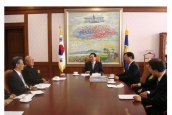
- 권오성 총무 사형폐지 촉구, 국회의장 방문
-
NCCK 권오성 총무, 천주교 주교회의 최기산 주교, 불교 종단협의회 진관 스님, 원불교 사회개혁 교무단 김대선 교무 등 그동안 사형폐지운동을 적극적으로 전개해 온 종단 대표들은 9월 18일 오전 10시 30분에 김형오 국회의장을 방문하여, 금번 18대 국회에서 사형폐지법안이 잘 처리될 수 있도록 협조 요청을 했다. 이 자리에는 의원발의를 준비중인 김부겸 민주당 의원과 박계동 국회사무총장이 함께 자리했다.
김형오 국회의장은 “일찍이 배운 바로는 사람이 사람을 죽일 수 있는 권리는 없다”는 것이라며, “17대 때에 사형폐지법안에 서명을 했는데, 현재 국회에서 사형제 폐지와 존치는 각각의 신념의 문제로서 그리 쉽지는 않다”고 개인 의견을 피력했다. 그러나 지금은 17대 국회와 많이 달라져, 좋은 기회라는 견해도 표했다. 이에 권오성 총무는 ‘종교의 입장은 사람의 생명을 존중하는 것인데, 문제는 이것이 법으로 만들어져 실효를 가져오는 것이 중요하다’면서, 이번 국회의장의 임기 중에 사회통합과 맞물려 잘 처리되기를 바란다“고 말했다.
9월 17일 광주고등법원은 사형에 대한 위헌 신청을 한 상태이기도 하며, 오는 10월10일 세계 사형폐지의 날을 맞아 국회도서관 강당에서 여야의원을 비롯해, 사형폐지범종교인연합과 인권시민단체들이 함께 ‘사실상 사형폐지국’ 행사를 준비 중에 있다.
향후 종단 대표들은 국회 법제사법위원회(위원장 유선호 의원)에 사형폐지 관련 논의와 상임위 안건 상정, 공청회 등을 제안하여, 18대 국회에서 또 다시 사형폐지법안 통과를 위한 총력을 기울이기로 했다.
2008-09-18 04:08:21
- Summarized report of 'Ecumenical Forum for Korea'
- The Ecumenical Forum for Peace, Reunification and Development Cooperation on the Korean peninsula
its 2nd meeting
1. Name: The 2nd meeting of the Ecumenical Consortium for Peace-Building and Social Development on the Korean peninsula
2. Date: February 7-8, 2008
3. Place: The Protestant Academy in Arnoldshain, Germany
4. Participants :
International representatives
WCC Dr. Mathews George Chunakara (Asia and Human Rights)
Rev. Keum Jooseop, (Mission and Evangelism)
CCA Mr. Tony Waworuntu (Justice, International affairs, Development Service)
Canada Ms. Bern Jagunos (Justice, Global and Ecumenical Relations)
Mr. Erich Weingartner (Consultant specializing in the DPRK)
Germany Rev. Paul Oppenheim (Ecumenical Relations, EKD)
Rev. Uliche Schmidt-Hesse(Mission and Partnership of EMS)
Mr. Lutz Drescher (East Asia, EMS)
Rev. Detlev Knoche (Development and Partnership, Hessen & Nassau Church)
Ms. Stefanie Elbern (South East and East Asia, and Pacific Area, EED)
England: Mr. Michael King(British Methodist Church)
Switzerland: Ms. Doris Ghros(Partnership in Asia, Mission 21 in Basel)
USA: Rev. Victor Hsu (World Vision International, DPRK)
Rev. Derek Duncan(Global Misnistry, UCC-USA and CC(DC)
Rev. Kim Jong Sung(Ecangelization and Church Growth, United Methodist Church)
Mr. James Reilly (China and DPRK, Amerian Friends Service Committee)
Korean Christian Federation in North Korea
Rev. Kang, Young-Sup (Chairperson of Central Committee, KCF)
Rev. Ri, Jong-Ro(International Affairs, KCF)
Mr. Kim, Tae-Jun(Mission Department, KCF)
Churches in South Korea
Rev. Kwon, Oh-Sung(General Secretary of NCCK),
Rev. Lee, Chong-Bok(Chair of Unification Committee, NCCK),
Rev. Kim, Gab-Sik(Chair of Unification Committee, PCK),
Rev. Kim, Jong-Seng(General Secretary of Society and Service, PCK),
Rev. Jeon, Yong-Ho(General Secretary of Seobu Conference, KMC),
Rev. Lee, Sang-Youn(General Secretary of Korean Christian Service, KMC)
Rev. Yoon, Kil-Soo (General Secretary, PROK)
Rev. Rah, Heak-Jip (Representative of Peace Community Movement, PROK)
Major Hwang, Sun-Yup(Coordinator, North Korea Mission, Salvation Army in Korea)
Pastor Kim, Gwang-Joon(General Secretary, Anglican Church of Korea),
Rev. Chi, Kwan-Hae(Stated Clerk, Evangelical Church of Korea),
Rev. Lee, Sam Yong(General Secretary, Korean Assemblies of God)
Rev. Hwang, Phil-Kyu(Director of Justice and Peace, NCCK)
Rev. Chae, Heawon (Coordinator, Ecumenical Forum for Korea)
Observer: Switzerland: Mr. Daniel Gerster (Agricultural Adviser, Agape International)
Germany: Mr. Yoon Sung-Min (Student of Heidelberg University)
On February 7-8, 2008 in Arnoldshain(Germany) "Ecumenical Forum for Peace, Reunification and Development Cooperation on the Korean Peninsula" (referred to hereafter as the Ecumenical Forum) was held as its 2nd meeting, attended by 35 participants representing churches and ecumenical bodies around the world including KNCC, KCF, CCA, WCC, and from Germany, Canada, United States, England and Switzerland.
The most significant feature in this meeting was to form a world-wide network for peace, reunification and development cooperation on the Korean peninsula especially through the participation of representatives from KCF and WCC which were not participating at the first meeting in Hong Kong. For the future direction of the Forum, the participation of the KCF as one of core members of the Forum for development cooperation is very significant. As well 14 Korean representatives from 7 member churches of NCCK have participated and expressed their commitment to the Forum.
At this meeting we have changed its name into "the Ecumenical Forum for Peace, Reunification and Development Cooperation on the Korean peninsula." It is for to make it clear that the Forum encompasses the importance of a world-wide network for development cooperation in the North as one column, as well as world churches" effort for peace and unification on the Korean peninsula in the solidarity with WCC, CCA, and other ecumenical bodies in continuation with the spirit of the Tozanso process as the other column. The term of "forum" instead of "consortium" is understood as more inclusive to make ecumenical bodies" participation into the forum reasonable.
At its first meeting in Hong Kong, we have shared the common understanding of that the problem of poverty in North Korea could not be resolved only by emergency humanitarian support began with severe flood and various disasters in the North since 1995, and of that the last over 10 years supports to North Korea which have been characterized by lack of information sharing, mutual cooperation and process of common evaluation, resulting in loss of trust, wasteful duplication and money-centered support. Therefore this Forum has taken its first step with common tasks which call us to share information and experiences in relation to North Korea and to plan effective projects in long term base and in mutual trust building through world-wide ecumenical network.
Regarding common project, the steering group, which will be newly consisted in May, is expected to take responsibility to deal. The steering group is consisted of 8 representatives from NCCK, KCF, CCA, WCC as well as from NCCJ on behalf of North East Asia, United Church of Canada on behalf of North America, Methodist Church in Britain, EKD/EED on behalf of Europe.
In the final Statement the Ecumenical Forum appealed " to Christians around the world to be in wholehearted solidarity with the efforts of the Korean nation towards achieving reunification, based on the principles of ensuring "co-existence, co-prosperity and common interests" and to be fully involved in development cooperation.
As you have been already informed, at the same place and just before the Forum there was a Korean-German Seminar on Peace, Unification and Social Development on the Korean peninsula(Feb. 5-7th), which was organized by German churches. It was an over 100 participants attending wonderful gathering for us to seek churches" role today for the Korean peninsula as well as to share experiences in relation to DPRK supports.
For your better understanding, I am enclosing some documents with this report:
1. the newly revised "Terms of Reference" of "The Ecumenical Forum for Korea"
2. Statement adopted by participants of the Forum.
3. Time table of "the Forum"
4. (only for participants) Draft of Minutes which was made by Mrs. Bern Jagunos with her hard work. It is needed to be checked by each of participants. Please give attention to it and feel free to make comments and send me your wording to add and revise.
2008-09-18 02:38:06
- Statement on the death of two middle-school girls
- (2003.02.26)Statement on the death of two middle-school girlsrun over by an American armored vehicleOn June 13 of this year, middle-school students Shim Mi-Sun and Shin Hyo-Soon were crushed to death by an armored vehicle of the United States Forces Korea (USFK) during a training exercise in Uijongbu, Kyonggi Province. In every case of accident or crime involving the US military forces in South Korea, the USFK have tried to suppress rather than accurately reveal the true facts of the incident. In the investigation process, the Korean prosecution and police have excluded and ignored the opinion and feelings of the bereaved families, only protecting the US parties. The high-handed attitude of the USFK has caused imbalance of the Status of Forces Agreement (SOFA). Under the unequal terms of the agreement, Korea has had no jurisdiction over many cases such as that of Yoon Kum-Ee, a young woman killed by a US soldier, and that of Cheon Dong-rok who was electrocuted to death by a high-voltage wire on a US military base. We cannot imagine the pain of the victims and suffering of the bereaved families.Civil and human rights groups are demanding revision of the SOFA, and the eradication of crimes by US troops in Korea. They have established the National Task-force Committee and held demonstrations in front of the US Embassy in downtown Seoul and the US Second Infantry Division in Uijongbu, Kyonggi Province. Urging disclosure of the truth, punishment of the Commander of the US Forces in Korea, and acknowledgement of responsibility for the homicide, they are requesting that the USFK waive jurisdiction of the case, and that an apology be issued by President Bush. With the bereaved families and the National Task-force Committee strongly speaking out, the USFK prosecuted Sgts. Fernando Nino and Mark Walker for the homicide. On July 19, Daniel R. Zanini, General Commander of the Eighth United Stated Army, expressed his sadness and acknowledged responsibility in this case, during the inauguration of Russel L. Ohnore as new General Commander of the US Second Infantry Division. Russel L. Ohnore also expressed his regret and apologized for the "terrible accident".After the accident, soldiers of the US Second Infantry Division raised a fund of only US$10,000 to give to the bereaved families. By providing this small amount of money, the USFK tried to close the case. In its report of July 20, the Ministry of Justice of the Republic of Korea announced the decision to give compensation in the amount of 196,260,000 Won to the family of Shin Hyo-Soon, and 195,450,000 Won to the family of Shim Mi-Sun. According to the terms of SOFA, the proportion of this compensation to be paid by the US military and the Korean government is 75% and 25%, respectively. In view of the earlier attitude of the USFK, this is regarded as a tremendous achievement gained through the continuous and determined efforts of civic and human rights groups.The Human Rights Committee of the National Council of Churches in Korea strongly demands that the USFK make its utmost efforts to establish specific policies and guarantee the disclosure of the truth, to ensure full protection in any future such cases.The USFK must waive its jurisdiction and allow the Korean authorities to jointly conduct the investigation. Further, the two countries must work together to revise the SOFA in the very near future. In addition, US President George W. Bush should officially apologize for the death of the two young girls, declaring respect for world peace and the dignity of lives. We strongly urge the Korean government to take positive action to formulate just policies and seek adequate means of protecting civilians from injury during military training exercises in Korea. July 22, 2002(Rev.) Paik Do-WoongGeneral SecretaryThe National Council of Churches in Korea(Rev.) Kim Jeom-MyungChairperson, Human Rights CommitteeThe National Council of Churches in Korea
2008-09-18 02:06:28
- DECLARATION OF THE CHURCHES OF KOREA
- (2003.03.10)DECLARATION OF THE CHURCHES OF KOREAON NATIONAL REUNIFICATION AND PEACEThe Mission Tradition of the Korean Churchesfor Justice and PeaceThe Reality of a Divided PeopleA Confession of the Sins of Division and HatredThe Basic Principles of the Churches of Koreafor National ReunificationThe Proposals of the Churches of Koreato the Governments of South and NorthThe Task of the Churches of Korea for Peaceand ReunificationThe National Council of Churches in KoreaDECLARATION OF THE CHURCHES OF KOREAON NATIONAL REUNIFICATION AND PEACEWe first offer praise and thanks for the grace and love of God, who has sent the Gospel of Christ to the Korean peninsula, making known to us the death of Christ on the Cross and his resurrection, and enabling us, through our faith in Christ, to be accepted as God"s children and granted salvation. We also give thanks for the presence of the Holy Spirit in the history of the Korean peninsula and in the lives of all of our brothers and sisters in faith, filling us with the mission commitment that will unify the whole church in our efforts for the liberation and salvation of our nation.We trust in one God, the Creator of the heavens and the earth (Genesis 1:1), and we believe that all people are invited to become the children of God (Romans 8:14-17, Galatians 3:26, 4:7).Jesus Christ came to this land as the "Servant of Peace" (Ephesians 2:13-19), proclaiming God"s kingdom of peace, reconciliation and liberation to a world torn by division, conflict and oppression (Luke 4:18, John 14:27).To reconcile humanity to God, to overcome divisions and conflicts, and to liberate all people and make us one, Jesus Christ suffered, died upon the Cross, was buried and rose again in the Resurrection (Acts 10:36-40).Jesus blessed the peace makers, declaring their acceptance as children of God (Matthew 5:9). We believe that the Holy Spirit will reveal to us the eschatological future of history, will unite us, and will make us partners in God"s mission (John 14:18-21. 16:13-14, 17:11).We the churches of Korea believe that all Christians have now been called to work as apostles of peace (Colossians 3:15) ; that we are commanded by God to overcome today"s reality of confrontation between our divided people - who share the same blood but who are separated into south and north; and that our mission task is to work for the realization of unification and peace (Matthew 5:23-24).Based on this confession of our faith, the National Council of Churches in Korea hereby declares before the churches of Korea and the world ecumenical community, our position and national unification and peace. At the same time our appeal is directed in a spirit of prayer to all our Korean compatriots and to the leaders of government in both south and north.The Mission Tradition of the Korean Churches for Justice and PeaceIt has been more than a century since Protestants first preached the Gospel in this land, and during this period the churches have committed many errors before the Korean people. And yet, through the proclamation of God"s Kingdom, Korean Christians have made great efforts to realize the true hopes of our people for liberation and independence. Our forebears in the faith, strengthened by the Holy Spirit and guided by the Scriptures (Luke 4:18-19), preached the Gospel to the poor, planted the hope of liberty and independence among our oppressed people, and pursued the mission of national liberation and independence as they shared the suffering of the whole Korean people under the slavery of the Japanese imperial rule.Korean Christians, however, could not find the true meaning of peace in the complacency and security of a life bowed down in obedient slavery.Peace had to be the fruit of justice (Isaiah 32:17), and a peace without national independence or human liberty was only a false peace (Jeremiah 6:13-14). The peace movement of the Korean churches during the Japanese imperialist rule over our land was necessarily a movement for national independence which shared the pain of our enslaved people-a national liberation movement which proclaimed the Kingdom of God and strived to realize this faith within history.The Christians of Korea stood in the forefront of the March First Independence Movement of 1919, resisted the policy of national annihilation by the Japanese imperialists, and shed martyrs" blood for their defiance of the enforcement of shinto worship, a deification of Japanese nationalism.After the division of Korea in 1945, the Christians of south Korea cared for the refugees, orphans and victims of war who were suffering under the reality of national separation. The churches received into their midst the members of churches and of separated families who had fled from the north, offering them love and support.As the division became a fized reality, dictatorial military regimes emerged to repress human rights in the name of security and to oppress laborers and farmers under the logic of economic growth; but the churches of Korea mounted resistance to such oppression, through a faith which sought justice and peace. The human rights and democratization movement of the Korean churches in the 1970"s and 1980"s is direct heir to this mission movement tradition for justice and peace.The Reality of a Divided PeopleThe division of the Korean peninsula is the sinful fruit of the present world political structure and existing ideological systems. The Korean people have suffered as a sacrificial lamb caught in the midst of the military and ideological confrontations and conflicts of the world"s superpowers.In 1945, at the end of the Second World War, the Korean people were liberated from their slavery under the Japanese imperial colonial rule, but were again shackled by the new fetters of the division into north and south. The line of division which was established in the name of disarming the aggressive Japanese imperialist forces became fized by the Cold War structure of the Soviet Union and the United States. The northern and southern parts of Korea separately established different governments, and over the last forty years their military, political and ideological antagonism and conflict has become ever more severe.The Korean Conflict which began on June 25, 1950, brought about the tragedy of internecine war and intensified the international conflict.The quantity of bombs dropped on Korea during this conflict exceeded the amount dropped on the whole of Europe during World War II; the entire peninsula was reduced to ashes. This war resulted in 220,000 south Korean, over 600,000 north Korean, 1,000,000 Chinese, 140,000 American, and over 16,000 United Nations military casualties, and if the number who died from disease during the war is included, a total of 2,500,000 soldiers" lives were sacrificed. If the 500,000 south Korean and 3,000,000 north Korean civilian casualties are added to this total, the blood of six million persons was spilled upon the earth of this land (statistics from the Encyclopedia Britannica, 1970 edition). In addition, three million refugees and ten million separated family members were produced by this conflict.In the time both preceding and following the Korean Conflict, Christians of north Korea who confronted the north Korean communist regime endured suffering and dearth, while hundreds of thousands of Christians from the north left their home communities and churches and underwent the hardships of refugee life as they fled to the south. During the Korean War a considerable number of south Korean Christianly were kidnapped or subjected to cruel, tragic executions. Communist sympathizers became victims of ideological warfare and were ostracized from society as "traitors".The Korean peninsula, reduced to ashes by the war, continued to be entangled in the international political conflict of the east-west Cold War structure, and as a result there was a steady escalation in military competition, mutual vilification, distrust and hostility between the north and the south. Peace on the peninsula was destroyed, and the general belief grew that national reconciliation would be impossible.With the hardening of the "armistice line"--originally intended as a temporary measure following the signing of the Armistice in 1953--into a "dividing line", the wall between north and south loomed ever higher, and in this context of separation and confrontation the two systems in the north and south became ever more hostile and aggressive toward one another. The mutual military rivalry has been accelerated to a state of armed readiness that counts 840,000 troops in the north and 600,000 in the south, for a total of some 1,500,000 troops on the peninsula; and the nuclear weapons now deployed here or targeted upon the peninsula constitute a destructive force more than sufficient to obliterate the whole Korean people.The prolongation of the division has led to violations of human rights under both systems, in the name of security and ideology; thus we have seen repression of the freedoms of speech, press, assembly and association. And the complete suspension by both sides of postal service, travel, visitation and communication has turned the two halves of Korea into the two most distant and different countries on earth. The education and propaganda activities of north and south share the goal of mutual vilification, each perceiving the other as the most hated enemy to be weakened and eliminated through the competition of the two systems.As a result the people of both north and south are not only ignorant of the life and culture of their fellow Koreans, but have been trained to believe they must not know about one another. Both systems are teaching their people to see their blood brothers and sisters as their most feared enemy.Dialogue between north and south was begun in 1972, and the July 4th Joint Communique of that year raised hopes for an opening that would lead to further dialogue, cooperation and exchanges. The Red Cross talks between north and south were reopened in 1985, and although some separated families were able to visit their home communities, their numbers were extremely limited, and dialogue and negotiations remain fruitless.Up to the early 1980"s, south Korean Christians were unable even to verify the existence of a church or Christian believers in the north; and their long-standing, deep-seated mistrust and enmity toward the communist regime--intensified and hardened as the division itself became hardened--kept Christians blindly attached to an anti-communist ideology.A Confession of the Sins of Division and HatredAs we Christians of Korea proclaim this declaration for peace and reunification, we confess before God and our people that we have sinned: we have long harbored a deep hatred and hostility toward the other side within the structure of division.1. The division of the Korean people is the result of the structural evil reflected in the world"s superpowers in their east-west Cold War system, and this reality has also been the root cause of the structural evil present within the societies of both North and South Korea. Due to the division we have been guilty of the sin of violating God"s commandment, "You shall love your neighbor as yourself". (Matthew 22:37-40)Because of the division of our homeland, we have hated, deceived and murdered our compatriots of the same blood, and have justified that sin by the political and ideological rationalization of our deeds. Division has led to war, yet we Christians have committed the sin of supporting rearmament with the newest and most powerful weapons, plus reinforcement of troops and expenditures, in the name of preventing another war. (Psalm 33:16-20; 44:6-7)In this process the Korean peninsula has become dependent upon outside powers, not only militarily but politically, economically and in other ways as well: it has been incorporated into the east-west Cold War structure and subjugated under that structure. We Christians confess that we have sinned during the course of this subjugation by abandoning our national pride and by betraying our people through the forfeit of our spirit of national independence. (Romans 9:3)2. We confess that throughout the history of our national division the churches of Korea have not only remained silent and continuously ignored the ongoing stream of movement for autonomous reunification of our people, but have further sinned by trying to justify the division. The Christians of both north and south have made absolute idols of the ideologies enforced by their respective systems. This is a betrayal of the ultimate sovereignty of God (Exodus 20:3-5), and is a sin, for the church must follow the will of God rather than the will of any political regime. (Acts 4:19)We confess that the Christians of the south especially have sinned by turing the anti-communist ideology into a virtual religious idol, and have thus not been content to treat just the communist regime in the north as the enemy, but have further damned our northern compatriots and others whose ideologies differ from our own (John 13:14-15; 4:20-21). This is not only a violation of the commandments, but is also a sin of indifference toward our neighbors who have suffered and continue to suffer under the national division; it is, moreover, a sin of failure to ameliorate their suffering through the love of Christ. (John 13:17)The Basic Principles of the Churches of Korea for National ReunificationSo that God"s Kingdom of justice and peace may come, we Christians must practice the Gospel of peace and reconciliation (Ephesians 2:14-17) by sharing in the life of suffering of our own people. It is only through such sharing that national reconciliation and reunification can be accomplished; thus we recognize that our concern and efforts for unification are an issue of faith. By overcoming the division which threatens the life of the Korean people and endangers world peace, reunification becomes the path leading us from conflict and confrontation to reconciliation and coexistence, and finally to one peaceful national community.Through a series of consultations beginning in 1984, the National Council of Churches in Korea has established the following basic principles of the churches toward national reunification.The National Council of Churches in Korea believes that the three broad principles articulated in the first north-south negotiated Joint Communique of July 4, 1972, namely 1) independence, 2) peace, and 3) great national unity transcending the differences in ideas, ideologies and systems should provide the guiding spirit for our nation"s reconciliation and reunification. In addition to these, we Christians believe that the following two principles also should be honored in all dialogue, negotiation and action for reunification.1. Reunification must bring about not only the common good and benefit of the people and the nation, but must provide the maximum protection of human freedom and dignity. Since both nation and people exist to guarantee human freedom and welfare, while ideologies and systems also exist for the sake of the people, primary consideration must always be given to humanitarian concerns and measures, which must never be withheld for any reason.2. In every step of the discussion process to plan for reunification, the full democratic participation of all the people must be guaranteed. Most importantly, participation must be guaranteed for the minjung (common people), who not only have suffered the most under the division, but who--despite the fact that they constitute the majority of the population--have consistently been alienated and excluded from the decision-making processes in society.The Proposals of the Churches of Korea to the Governments of South and NorthBased upon the above principles, the National Council of Churches in Korea urges the responsible authorities in the governments of both north and south to exert their utmost efforts for dialogue so that the following may be accomplished as soon as possible.1. For the healing of the wounds caused by divisiona. First of all, the separated families, who--as the victims of the division--have endured all sorts of suffering during the past 40 some years, must be reunited and allowed to live together, and must be guaranteed the right to move freely to whatever place they choose to live.b. Even before reunification is achieved, all persons living in separation from family members in north or south must be freely permitted to visit their relatives and home areas for definite periods, on an annual basis(perhaps at Chusok¹or some other holiday season).c. The unjust social discrimination which still prevails against some persons because of their momentary errors or the past records of their families or relatives, problems which inevitably arose during the solidifying of the national division, must be ended at once.2. For the promotion of the people"s genuine participation to overcome the divisiona. Neither government, north or south, may exercise a monopoly over information about the other side, nor monopolize the discussion on reunification. Freedom of speech must be guaranteed so that the people of both north and south may participate fully and freely in the process of discussing and establishing policies for reunification, and there must be systemic and realistic guarantees of the activities of civilian organizations engaged in research and discussion of the reunification issue.b. Both North and South Korea must grant maximum freedom for people who oppose either system or ideology to criticize freely according to their conscience and faith, and both must abide by the International Declaration of Human Rights and the United Nations" Human Rights Covenant.------------------------1. Korean Thanksgiving day3. For a great national unity of the Korean People transcending the differences in ideas, ideologies and systems.If Korea is to realize national autonomy, the people of both north and south will have to transcend their differences in concepts, ideologies and systems, and both populations must be able to clearly confirm for themselves that they are one people sharing a common fate. For such a mutual confirmation, north and south must be able to put firm trust in one another. It follows that those things which enable mutual trust must become the most basic starting point for all efforts directed toward reunification. To foster such trust, all factors giving rise to mistrust and hostility must be eliminated, while mutual exchanges should be expanded to broaden our base of mutual understanding and rapidly restore our sense of common ethnic identity. Because all such measures aimed at fostering trust are the most essential part of the process of overcoming division, even in the case that discussions between the official representatives of the two governments do not show progress, or agreement are not forthcoming, there must nevertheless be non-governmental channels through which the citizens themselves may seek progress.a. North and South Korea must put an end to all mutual hostility and aggressive inclinations, and must eliminate the exclusivism which leads to the slandering and vilification of one another. In addition, each must modify its extreme, emotional censure of the other"s differing ideology and system and offer in its place mutually constructive criticism.b. For the promotion of mutual understanding, north and south need unprejudiced, objective information about each other"s situation; therefore exchanges, visits and communications must be opened.c. In order to restore the sense of common ethnic identity, north-south exchanges and cooperative research must be promoted in such academic areas as language, history, geography, biology and natural resources; while exchanges must also be carried out in the areas of culture, the arts, religion and sports.d. Since economic exchanges between north and south will not only benefit the people but will also provide opportunities for mutual understanding, they should be opened to the greatest possible extent.4. For reduction of tensions and promotion of peace between North and South Koreaa. In order to prevent war and reduce tensions on the Korean peninsula, a peace treaty must immediately be concluded to terminate the existing state of war. To this end, it is urgent that negotiations be opened by the governments of North and South Korea, the United States, China which participated in the Korean Conflict, to replace the Armistice Agreement with a peace treaty which also includes a non-aggression pact.b. At such time that a peace treaty is concluded, a verifiable state of mutual trust is restored between north and south Korea, and the peace and security of the entire Korean nation is guaranteed by the international community, then the United States troops should be withdrawn and the United Nations Command in Korea should be dissolved.c. The excessive military competition between North and South Korea is the greatest obstacle to peaceful reunification and is moreover counter-productive to economic progress.Therefore, following negotiations between north and south, mutual military strength must be reduced and military expenditures must be cut, with a switchover to industrial production for peace.d. Nuclear weapons must never be used under any circumstances. North and South Korea together must block from the start any possibility of the use of nuclear arms on the Korean peninsula. This means that all nuclear weapons deployed on the peninsula or aimed in its direction must be removed.5. For the realization of national independencea. The must be no foreign interference or dependency upon neighboring superpowers in negotiations, conferences, or international agreements between north and south; the Korean people"s self-governing and subjecthood must be protected.b. Both North and South Korea must either revise or abrogate all diplomatic agreements and treaties which undermine rather than support the life and interests of the Korean people.North and south Korea must also reach mutual agreement in regard to all international alliances and associations, examining them to make certain that the common good of all Koreans is their primary objective.The Task of the Churches of Korea for peace and ReunificationWe believe that Jesus Christ is the "Lord of Peace" (Colossians 1:20), and that God"s mission of salvation and liberation for humankind is being realized also within societies that have ideas and systems different from our own. Even though the confession of faith and the appearance of the churches of Christians living in other social systems may be unlike ours, we believe that since they are bonded to the one God and the one Christ, thereby they are members with us in the same Body(Corinthians 12:12-26).Within the last few years, in an amazing development, the world ecumenical community has greatly strengthened this conviction of ours, by making contacts with our sisters and brothers in faith in North Korea, and bringing us news of them.Again we give thanks for God"s liberating action in the history of the Korean peninsula, and pray for God"s grace and blessing upon our sisters and brothers in the north who are steadfastly keeping the faith even under difficult circumstances.Based upon this confession, the National Council of Churches in Korea, in order to fulfill its mission for peace and reconciliation, to share in the suffering division has caused, and to respond to the historical demand to overcome the division, now in a spirit of repentance and prayer announces plans to initiate a movement for a Jubilee Year for Peace and Reunification, as follows.1. The National Council of Churches in Korea proclaims the year 1995 to be the "Year of Jubilee for Peace and Reunification"."The Spirit of the Lord is upon me,because he has anointed meto preach good news to the poor.He has sent meto proclaim release to the captivesand recovering of sight to the blind,to set at liberty those who are oppressed,to proclaim the acceptable year of the Lord". (Luke 4:18-19)The "Jubilee year" is the fiftieth year following the completion of a cycle of seven sabbatical years totaling 49 years (Leviticus 25:8-10). The year of jubilee is a "year of liberation". The proclamation of the year of jubilee is an act of God"s people which reveals their complete trust in God"s sovereignty over history and their faithfulness in keeping God"s covenant. The jubilee year is the overcoming of all the social and economic conflicts caused by the repressive and absolutist political powers, internal and external: the enslaved are liberated, the indebted have their debts forgiven, sold land is returned to its original tillers, and seized houses are returned to their original inhabitants (Leviticus 25:11-55); the united covenant community of peace is restored through the establishment of Shalom based on God"s justice. The Korean churches proclaim 1995, the fiftieth year after Liberation, as a Jubilee Year, to express our belief in the historical presence of God, who has ruled over those fifty years of history--indeed, over all of human history; to proclaim the restoration of the covenant community of peace; and to declare our resolution to achieve this restoration in the history of the Korean peninsula today, As we march forward with high aspirations toward the Year of Jubilee, we should experience a revitalized faith in the sovereignty of God, who works within our people"s history, and renewed commitment to the calling of God"s mission.2. As a part of the "Great March toward the Jubilee Year" the Korean churches will carry out a vigorous church renewal movement aimed toward peace and reunification.a. In order to fulfill their mission responsibility for peace and reunification, the Korean churches must overcome their self-centeredness and their preoccupation with ecclesiastical power, while greatly strengthening mission cooperation for church unity.b. The churches of Korea, proclaiming the Year of Jubilee, must reform their internal structures which have restricted broad participation. Accordingly there must be a resolute opening and expediting of full participation in lay mission activity which will include women and youth.c. In order to bring about economic and social justice in our society, the churches of Korea must continue to perform a prophetic role.3. As a part of the proclamation of the Jubilee Year, the churches of Korea, as a community of faith resolved to achieve peace and reconciliation, will carry out a broad program of education for peace and reunification.a. The churches of Korea will widely disseminate Biblical and theological peace studies and peace education materials, and will promote research and exchange of information among the various theological and Christian educational institutions.b. To increase concern among the churches for the national reunification issue, the Korean churches will promote unification education which will foster recognition of the historical, social and theological validity of national reunification through an understanding of the structure and history of the division, as well as through a deeper theological understanding of the problem.c. Through theological reflection and commitment to the Christian faith, the Korean churches will seek a broader scientific understanding of the communist ideology and will promote research and education on ideology as needed for substantial dialogue.4. Through the proclamation of a Jubilee Year festival and liturgy for peace and reunification, the Korean churches will seek to bring about a renewal of faith and genuine reconciliation and unity.a. The churches of Korea will establish a "Sunday of Prayer for Peace and Reunification" to mark the Year of Jubilee, and will develop a form of worship for this purpose, which will include prayers for reunification, confession of the sin of division, recognition of calling and commitment for unification, prayers of intercession for the victims of division and the divided people, a confession of faith for national reconciliation, proclamation of the Word(proclaiming the Jubilee Year), hymns and poetry, and a sacrament for peace and reconciliation.b. Until the time when communication between the churches of north and south becomes possible, we will seek the cooperation of the would churches to enable the joint proclamation in both north and south of the Jubilee Year for Peace and Reunification, and will promote the common observance of the "Sunday of Prayer for peace and Reunification" and the joint preparation and use of "prayers for peace and reunification".c. with the cooperation of the world churches, the churches of Korea will search for ways to confirm the status of separated family members, explore the possibility of exchanging letters, and develop a movement to search out relatives, church members and friends separated between north and south.5. The churches of Korea will work continuously to develop a solidarity movement for peace and reunification.a. The proclamation of the Jubilee Year for peace and Reunification, as an act of confession of faith, will be developed into a continuously expanding "solidarity movement for peace and reunification". This must be a comprehensive movement embracing all the churches at local, denominational and ecumenical levels. The National Council of Churches in Korea especially will make efforts to include not only its member churches, but also non-member denominations and the Roman Catholic Church in this movement for confessional action and practice for peace and reunification.b. As the mission calling to peace and reunification is the universal task of all Christians on the Korean peninsula, the churches of South Korea will pray for the faith and life of the Christian community in the North and will work for North-South exchanges between our churches.c. Because peace and reunification on the Korean peninsula is a key to peace not only in Northeast Asia but throughout the world, the churches of Korea will consult closely and develop solidarity movements with Christian communities in the four powerful countries related to the region--the United States, the Soviet Union, China and Japan, as well as with churches throughout the world. *d. The Korean churches will expand and deepen dialogue with other religious groups and movements, and through joint research and cooperative activities, will work to promote ever stronger solidarity for the realization of peace and the reunification of this nation.February 29, 1988The National Council of Churches in Korea* Such activity is already in progress, and the National Council of Churches in Korea endorses the proposals and positions which have been expressed in such published consultation reports as: "Findings and Recommendations" of the 1984 Consultation in Tozanso, Japan; Message of the Fourth Korean-North American Church Consultation, 1986; the policy statement and declaration of the National Council of Churches of Christ in the U.S.A., "Peace and the Reunification of Korea", 1986; and the joint statement of the Sixth Korean-German Church Consultation, 1987.
2008-09-18 02:09:09
- The Korea Crisis and the Korean Church
- (2003.06.26)
(This writing was announced from "an Ecumenical Consultation on the Korea Crisis" at June 16-18, 2003, Jurys Washington Hotel, Washington D.C.)
The Korea Crisis and the Korean Church
* Jongwha Park / Vice Moderator, NCCK
[Facing an Endgame on the Korean Peninsula]
Five decades of the Cold War era, of a zero-sum confrontation in the peninsula are gone with the time, but its scars remain uncured and still soaring. The Koreans on both sides know that to overcome division and to achieve unification might be a longer way to go than expected, when they are crying for a peaceful reunification of the peninsula. Recent developments culminating in the June 15th Summit of 2000 between North and South Korea could, however, signal quite a new possibility of living together, of a coexistence in peace. Considering the deep-rooted enmity in which each side sought to conquer the whole peninsula red-colored or to absorb the other to be blue-colored, as coincidently shown in the South Korean flag, we dare to speak of a epoch-making and marvelous change of mind of people. In the course of half a century long division conflicts there stands the Korean War in the center having costed millions of people"s lives including both Koreans and foreign military people including US Americans. A collective yes to reunification and peace but not through war at any rate!
The change of people"s mind is "epoch-making", because the world has shown that the collective collapse of the communist powers which brought the ideological block conflict to an end was made without war and the Koreans could believe that their yearning for a unified Korea will be accomplished peacefully in the end. In mutual encounters and cooperations people began getting to know each other, if limited in scope, and came to a firm conviction that either a conquest or an absorption should necessitate a war, which is to be more cruel and disastrous than the former one from which we still suffer tremendously. Just a peaceful means to reunification is considered to be acceptable, and for that purpose a series of actions together was put into practice in offering emergency assistances, enhancing social and cultural exchanges, making possible reunion of separated families and mutually visiting Christians and churches in Korea and abroad.
It is also "marvelous" to mention that most South Koreans get to know the truth of the North Korean situation more realistically. Bellicose utterances of the North, often deadly threatening and intimidating, signify rather stereotyped brinkmanship tactics to get more concessions in negotiations and to more effectively control its domestic politics. In the South Korean political arena the North Korean "threats" function no more effective in attracting the "fearful" voters for the sake of mostly ruling government parties, which had often been the case in the Cold War era. We might speak of a political disenchantment of North Korea In the South Korean situation. This means that people in the South take serious any military provocations and possible Invasion from the North, when it feels it lies in the boundary and no way out for survival. A suicidal attack or war using WMD is not to be ruled out, and a massive disaster on both sides is clearly to be seen. We seek a common national identity and interest of two Koreas on the basis of a peaceful coexistence aiming at peaceful reunification. We know that a Korean war, if any, invites consequently surrounding countries" involvements, whichever they may be, and it ruins peace and common security on the peninsula and also in the region.
The Korean "crisis" is twofold : it contains a significant "danger" of a tragic war and at the same time a flourishing "opportunity" of a lasting peace, At the moment we see we face an end phase of decisions to make above all in face of issues of North Korean nuclear weapons on the one hand and its system survival on the other. Regarding the situations of the peninsula just after the War in Iraq we are very keenly alert to the critical moment of crisis on the peninsula. In the following let me introduce some core elements of "Peace Statement Against War and Nuclear Weapons" signed by 300 ecumenical leading People belonging to KNCC and some to evangelical circles (issued 77arch 31, 2003 in the name of Christian Solidarity for Peace).
[Free of Nuclear Weapons on the Peninsula]
"We urge the North Korea clearly state its intent to immediately stop its nuclear weapons development program, and to participate in peace settlement in Korea and North East Asia".
We oppose the production, development, possession, deployment and use of nuclear weapons which can lead to mass destruction. We call for the implementation of the Basis Agreement on a Nuclear-Free Korea which was signed in December 1991 by the governments of both Koreas. We know that non-nuclear states are deeply frustrated because they are not allowed to develop nuclear weapons, whereas those states already possessing nuclear weapons are highly arrogant. We believe that the question of whether we can maintain peace and security with or without nuclear weapons is not simple. Any attempt to possess nuclear weapons will endanger security and can result in enormous tragedy and destruction.
North Korea clearly declare its willingness to give up its nuclear weapons development program for the sake of the life and very existence of its people and for the survival guarantee of its regime. We urge North Korea to return to the NPT, fulfill its agreement on a nuclear-free Korea, and return to the Inter-national inspection system. We hope that both Koreas will work together to build a nuclear-free peace.
[For Peace Negotiations of Washington and Pyongyang]
"We call upon the United States to make concrete responses to North Korea in guaranteeing the regime survival and the life of its people in return for North Korea"s renunciation of its nuclear weapons programs".
We cannot support any policies leading to armed conflict and, potentially, war In Korea. We cannot accept the US administration"s branding of North Korea as an"axis of evil" or an "outlaw state". We cannot agree with the US policy of pre-emptive nuclear strikes, becauee such a policy can lead to war on the peninsula.
On the other hand, we support the US position to solve the Korean nuclear crisis by diplomatic efforts and dialogue, In accordance with North Korea"s cancellation of its nuclear weapons programs, the US must resume its supply of oil which was promised under the Geneva Agreed Framework and which was suspended in the wake of the North Korean nuclear crisis. We urge the US to immediately enter into dialogue with North Korea to negotiate about the issues of very existence of its people, guarantee of its regime, and a non-aggression pact.
[For Inter-Korean Solidarity and US-South Korean Alliance]
"We urge the South Korean government to make every effort to eliminate the threat of war and pave the way for a peace settlement by combining our commitment to solidarity between North and South and our commitment to the US-South Korea alliance"
We denounce war under any circumstances in Korea. We do not want repeat the agony and suffering of the Korean War. We call on the South Korean government to do its best to dismantle the Cold War structures by extensively enhancing the on-going South-North peaceful coexistence. Peace between North and South Korea is not possible without peace with surrounding nations. We, therefore, urge the South Korean government to work on a framework of multilateral dialogue and cooperation including the US, which has armed forces stationed in South Korea, the surrounding nations and if possible, the EU.
This multilateral framework may contribute to the construction of peace and security not only on the Korean peninsula but in all of Northeast Asia.
We call upon the South Korean government to contribute to strengthening the South-North cooperation, US-North Korea dialogue and a multilateral security framework to ensure a sustainable and permanent peace in the region.
[For Christian Solidarity for Peace]
"We ask sister churches around the world and the churches in North and South Korea to work together to plant the seed of peace in the world and on the peninsula".
We appeal to all peace-loving people in the world to join together in preventing war and building peace, and to work for justice and the welfare of all people. We firmly believe that we can achieve a new vision of church unity by participating in peace without war and nuclear weapons, beyond the barriers of theological doctrines and historical and cultural differences.
[For A Lasting Peace in Korea and the Region]
A non-nuclear, democratic, reconciled, prosperous and unified Korean peninsula may well be accepted as future vision by Koreans and also by the world including the USA. A peaceful resolution of the Korean division conflict is in compliance with the wishes of the Korean people. Furthermore they want the US and allies to effectively manage the conflicts in a way that Cold War structures in the peninsula could peacefully, that is, without war, be dismantled up to the stage sawing the seed of security and peace in Northeast Asia.
An agreement of non-nuclear assurance by North Korea and its survival guarantee by the US is pivotal in the conflict resolution. At a lower level there should be a follow-up negotiation of the reduction, redeployment and restructuring of forces and arms confronted against each other, which includes also the issues of pullback of their forward-deployed conventional forces. We Koreans want badly in such a severe process to suggest a common security formula containing surrounding nations like China, Japan, Russia. In this respect the US may play best a peace-making role in the region as in the case of Europe.
Reunification and peace are in separable in the minds of the Korean people. When the two are, however, in the short term period optional, then the Koreans make a clear stance in my observation that a peace in division and coexistence has the priority over a reunification through war. Here we are clearly aware of the fact that a reunification aims at building peace on the Korean peninsula and in the region. Koreans have a dream of a drastic change of situation, a dream of building a "world peace garden" in Panmujom making the whole of the DMZ a "peace zone", if and when the security and peace on the peninsula and in the region has to have its concrete shape.
2008-09-18 02:15:35
- 2007 Declaration of the Summit
- Declaration on the Advancement of South-North Korean Relations, Peace and Prosperity
In accordance with the agreement between President Roh Moo-hyun of the Republic of Korea and Chairman Kim Jong Il of the National Defense Commission of the Democratic People’s Republic of Korea, President Roh visited Pyongyang from October 2-4, 2007.
During the visit, there were historic meetings and discussions.
At the meetings and talks, the two sides have reaffirmed the spirit of the June 15 Joint Declaration and had frank discussions on various issues related to realizing the advancement of South-North relations, peace on the Korean Peninsula, common prosperity of the Korean people and unification of Korea.
Expressing confidence that they can forge a new era of national prosperity and unification on their own initiative if they combine their will and capabilities, the two sides declare as follows, in order to expand and advance South-North relations based on the June 15 Joint Declaration:
1. The South and the North shall uphold and endeavor actively to realize the June 15 Declaration.
The South and the North have agreed to resolve the issue of unification on their own initiative and according to the spirit of “by-the-Korean-people-themselves.”
The South and the North will work out ways to commemorate the June 15 anniversary of the announcement of the South-North Joint Declaration to reflect the common will to faithfully carry it out.
2. The South and the North have agreed to firmly transform inter-Korean relations into ties of mutual respect and trust, transcending the differences in ideology and systems.
The South and the North have agreed not to interfere in the internal affairs of the other and agreed to resolve inter-Korean issues in the spirit of reconciliation, cooperation and reunification.
The South and the North have agreed to overhaul their respective legislative and institutional apparatuses in a bid to develop inter-Korean relations in a reunification-oriented direction.
The South and the North have agreed to proactively pursue dialogue and contacts in various areas, including the legislatures of the two Koreas, in order to resolve matters concerning the expansion and advancement of inter-Korean relations in a way that meets the aspirations of the entire Korean people.
3. The South and the North have agreed to closely work together to put an end to military hostilities, mitigate tensions and guarantee peace on the Korean Peninsula.
The South and the North have agreed not to antagonize each other, reduce military tension, and resolve issues in dispute through dialogue and negotiation.
The South and the North have agreed to oppose war on the Korean Peninsula and to adhere strictly to their obligation to nonaggression.
The South and the North have agreed to hold talks between the South’s Minister of Defense and the North’s Minister of the People’s Armed Forces in Pyongyang in November to discuss ways of designating a joint fishing area in the West Sea to avoid accidental clashes and turning it into a peace area and also to discuss measures to build military confidence, including security guarantees for various cooperative projects.
4. The South and the North both recognize the need to end the current armistice regime and build a permanent peace regime. The South and the North have also agreed to work together to advance the matter of having the leaders of the three or four parties directly concerned to convene on the Peninsula and declare an end to the war.
With regard to the nuclear issue on the Korean Peninsula, the South and the North have agreed to work together to implement smoothly the September 19, 2005 Joint Statement and the February 13, 2007 Agreement achieved at the Six-Party Talks.
5. The South and the North have agreed to facilitate, expand, and further develop inter-Korean economic cooperation projects on a continual basis for balanced economic development and co-prosperity on the Korean Peninsula in accordance with the principles of common interests, co-prosperity and mutual aid.
The South and the North reached an agreement on promoting economic cooperation, including investments, pushing forward with the building of infrastructure and the development of natural resources. Given the special nature of inter-Korean cooperative projects, the South and the North have agreed to grant preferential conditions and benefits to those projects.
The South and the North have agreed to create a “special peace and cooperation zone in the West Sea” encompassing Haeju and vicinity in a bid to proactively push ahead with the creation of a joint fishing zone and maritime peace zone, establishment of a special economic zone, utilization of Haeju harbor, passage of civilian vessels via direct routes in Haeju and the joint use of the Han River estuary.
The South and the North have agreed to complete the first-phase construction of the Gaeseong Industrial Complex at an early date and embark on the second-stage development project. The South and the North have agreed to open freight rail services between Munsan and Bongdong and promptly complete various institutional measures, including those related to passage, communication, and customs clearance procedures.
The South and the North have agreed to discuss repairs of the Gaeseong-Sinuiju railroad and the Gaeseong-Pyongyang expressway for their joint use.
The South and the North have agreed to establish cooperative complexes for shipbuilding in Anbyeon and Nampo, while continuing cooperative projects in various areas such as agriculture, health and medical services and environmental protection.
The South and the North have agreed to upgrade the status of the existing Inter-Korean Economic Cooperation Promotion Committee to a Joint Committee for Inter-Korean Economic Cooperation to be headed by deputy prime minister-level officials.
6. The South and the North have agreed to boost exchanges and cooperation in the social areas covering history, language, education, science and technology, culture and arts, and sports to highlight the long history and excellent culture of the Korean people.
The South and the North have agreed to carry out tours to Mt. Baekdu and open nonstop flight services between Seoul and Mt. Baekdu for this purpose.
The South and the North have agreed to send a joint cheering squad from both sides to the 2008 Beijing Olympic Games. The squad will use the Gyeongui Railway Line for the first-ever joint Olympic cheering.
7. The South and the North have agreed to actively promote humanitarian cooperation projects.
The South and the North have agreed to expand reunion of separated family members and their relatives and promote exchanges of video messages.
To this end, the South and the North have agreed to station resident representatives from each side at the reunion center at Mt. Geumgang when it is completed and regularize reunions of separated family members and their relatives.
The South and the North have agreed to actively cooperate in case of emergencies, including natural disasters, according to the principles of fraternal love, humanitarianism and mutual assistance.
8. The South and the North have agreed to increase cooperation to promote the interests of the Korean people and the rights and interests of overseas Koreans on the international stage.
o The South and the North have agreed to hold inter-Korean prime ministers’ talks for the implementation of this Declaration and have agreed to hold the first round of meetings in November 2007 in Seoul.
o The South and the North have agreed that their highest authorities will meet frequently for the advancement of relations between the two sides.
Oct. 4, 2007
Pyongyang
Roh Moo-hyun President Republic of Korea
Kim Jong Il Chairman, National Defense Commission Democratic People’s Republic of Korea
2008-09-18 02:35:56
- Welcome Declaration Summit
- (2007.10.09)We positively welcome the outcome of the Summit meeting between the North and the South. The NCCK has welcomed that the President Roh Moo-Hyun of South Korea and Chairperson Kim Jung-Il of North Korea hold the Summit meeting on October 2-4th in Pyongyang and has reached to a declaration for Peace and Prosperity on Korean peninsula. Regarding the result of the agreement, even though we have different opinions in evaluating it and are not sure of how it will be implemented, there is no doubt to point out that the summit meeting between the two leaders itself is very important, and it paves for peace and prosperity on Korean peninsula. Therefore we strengthen that it is not necessary to predict and criticize the result of the Summit meeting with a political reason. The NCCK had highly evaluated the first Summit meeting which opened a new opportunity to mutual understanding between two Koreas, relationship development, Peace and Unification. We believe that this second Summit meeting has reaffirmed a positive implementation of the June 15 Joint Declaration and inherits and fosters February 13 agreement, and that it will contribute on reconciliation, unification and prosperity of our nation and building peace system on Korean peninsula. We strongly emphasize that in the situation facing with presidential election on this coming December this Summit should not be politically misinterpreted or denounced scathingly by politicians and candidates for presidential election, and rather we urge those candidates and politicians to participate in our effort for bringing about peace on Korean peninsula. This declaration is dealing with very practical and important issues itemized as 8 points. However support, implementation and participation by people after declaration is more necessary and important. In the solidarity with sisters and brothers of world churches, the NCCK, which has prayed and worked for the reconciliation, peace and unification of the North and the South, warmly welcomes again the outcomes of the second Summit and will make our every effort to accomplish peace settlement on Korean peninsula. October 5th, 2007 Rev. Kwon Oh-Sung, General Secretary of NCCK Rev. Lee Jong-Bok, Chairperson of Reconciliation and Unification Committee
2008-09-18 02:27:18
- The Enthronement of His Eminence Sotirios
- (2004.06.18)St. Paul’ Orthodox Weekly News (04-06-18)
The Enthronement of His Eminence Sotirios, the First Metropolitan of the Orthodox Metropolis of Korea
Seoul, Korea: The inauguration of the Enthronement Ceremony of His Eminence Sotirios, the First Metropolitan of the Orthodox Metropolis of Korea is ignited by the arrival of His Eminence Archbishop Dimitrios of America, the official Representative of His All Holiness Bartholomew I, the Ecumenical Patriarch, on 18th June, 2004 at the Incheon International Airport, Korea, accompanied by a Archdiocesan Arch-Deacon.
Prior to His Eminence’s arrival in Korea today, four Hierarchs (H.E. Dionysios of Broussa -fomer Exarch of Korea-, H.E. Euthymios of Aheloos, H.E. Efraim of Hydra, H.E. Symeon of Nea Smyrni), three clergymen from Greece (Rev. Nicholaos Tsimogiannis, Rev. Nikodemos Giannakopoulos, Rev. Demetrios Dimitreas), and seven laypeople from Greece including Mr. Andreas Cheliotis (theologian) had arrived in Korea on 16th June, 2004.
On 17th June, 2004 His Eminence Sotirios had His first official local News Conference on the historical occasion of the Establishment of the Orthodox Metropolis of Korea, right after His two months’ visit to Greece and Constantinople ended on 16th June, 2004. There were about 20 Religious Journalists including the several from Daily Newspapers. His Eminence collaborated the News Conference with H.E. Dionysios, former Exarch of Korea, H.E. Euthymios of Aheloos, His Grace Bishop Chang Moo Choi, the Chairperson of the Bishopric Synod of the Catholic Church in Seoul, and two representatives from the KCRP(Korea Conference Religion and Peace) and the KNCC(Korea National Council Churches). Two major Daily Newspapers have reported today the statements of His Eminence and announced the date of the Enthronement of His Eminence at St. Nicholas Cathedral in Seoul.
The official program of the participants of the Enthronement of His Eminence Sotirios, the Metropoltan of Korea is as the following;
18th June, 2004 (Friday)----Vespers at the Transfiguration Monastery in Ka-Pyung
19th June, 2004 (Saturday)---Vespers at the St. Paul Orthodox Church in Incheon
20th June 2004 (Sunday)---Hierarchical Divine Liturgy followed by the Ceremony of the Enthronement of His Eminence.
The members of the Philoptochos Society of the St. Nicholas Community in Seoul will host the participants for Luncheon at the Mission Hall, which will be followed after the Ceremony.
More News will be followed as soon as the materials available on the Event.
St. Paul Orthodox Press
Photo/His Eminence Dimitrios of America, Archimandrite Ambrosios Zographos, Protopresbyter Daniel Na, Presbytera Olympia Young Sook Na, and Ms. Yulia Soon Ja Kang.
2008-09-18 02:20:40
- NCCK sent a letter on the Takeshima [Dokdo Island]
- (2005.03.22)Dear Rev. Toshimasa Yamamoto Greetings in the name of Jesus Christ !In commemoration of the 60th anniversary of the Liberation of Korea from Japanese colonial rule and of the Japanese defeat of the Pacific War, and also in commemoration of the 40th anniversary of the reopening of the diplomatic relationship between South Korea and Japan, we, the National Council of Churches in Korea (NCCK), have worked closely the National Christian Council in Japan (NCCJ) to bury the unfortunate past and to promote friendly relations between the two nations. It is, therefore, our great regret to hear that today the parliament of Shimane-prefecture in Japan made a very inappropriate decision to observe "Takeshima [Dokdo Island] Day" as if Dokdo is Japanese territory. It is also our great regret to hear that some Japanese textbook tries to distort and twist the historical facts of Japanese invasion to Korea, and that Japanese court of law has continuously refused to recognize the unfair treatment of Korean forced laborers.We cannot but doubt whether the Japanese government truly reflects on its misconduct in the past and has a genuine will to promote a good relationship with neighboring countries. The Japanese government must learn from the German government which has made from time to time sincere apologies for its historical crimes and which tries to remember the unfortunate past by promoting joint research on history with neighboring nations. We appreciate and admire that the NCCJ, though a minority in number, has made its sincere and sustaining effort to prevent the Japanese government from turning ultraconservative and to promote and preserve good neighborly relations with various Asian countries.We ask the NCCJ, Japanese churches, and Japanese intellectuals for a more consolidated effort to guide the Japanese government back to the right path toward a new history of mutual respect and benefits in the region. We, the churches in Korea, will also do our best to overcome the present crisis between the two countries. In closing, we would like to thank you again for your cooperation and solidarity.Sincerely yours,Paik. Do-Woong(Rev.) General SecretaryNational Council of Churches in KoreaCC. Rev. Park. Soo-Kil, General Secretary, Korea Christian Church in Japan
2008-09-18 02:21:57
- 2003 Common Prayer for Peace and Reunification of
-
(2003.07.18)2003 Common Prayer for Peace and Reunification of the Korean PeninsulaGracious God,
We who live in a time of suffering gather our hearts in prayer
to you our Lord who cares for this world with your loving hands.
We live in a land
that cries out with the tears falling from 70 million crosses.
Crosses of separation!
Pain, more painful than words, hangs upon these crosses, O Lord.
The Joint Statement of June 15, 2000
was a symbol of peace which you granted to us
so that we may cast off our burdensome cross of division
and seek lasting peace on the Korean Peninsula.
But even now, as we pass through this month of August in the year 2003
we strain under the cross of division.
Our failure to grasp your wisdom, our lack of your spirit-filled motivation
only adds to the weight of the burden we carry.
O God,
Forgive us our weakness.
You challenge us to face each other more often, to love each other more deeply,
to open our hearts to understand each other more clearly,
but we have failed in these things.
O God,
Grant to us new strength and power.
Give us the courage to fulfill your will in our lives and our nation"s history.
Lead us to close the chapter of fifty painful years under the Armistice.
Guide us to full commitment to end the war, and to move forward to peace.
Loving God,
We turn yearningly to you in our prayers.
May our faith in you blossom and bear the fruit of love for our 70 million sisters and brothers.
May the tears and pain of 70 million become the joy and song of 70 million.
Lead us so that through the autonomous actions of cooperation between North and South our boundaries of peace and mutual existence may become wider.
Hear this, our prayer of our heart"s deepest desire.
Grant to us the day when we shall sing for joy in peace, a unified people.
Give us this day, and may it come soon, O God.
We pray this in the name of the One who gives us peace, Jesus Christ.
Amen.
2008-09-18 02:16:19
- The Statement On the "North Korean Human Rights A
- The Korean Civil Society’s Statement
Onthe passageof “North Korean Human Rights Act of 2004”
in the House of Representative
ByMINBYUN(Lawyers for a Democratic Society), SARANGBANG Group for Human Rights, Good Friends, Center for Peace and Disarmament of the PSPD (People"s Solidarity for Participatory Democracy), Catholic Human Rights Committee in Korea,Democratic Legal Studies Association,The Human Rights Committee The National Council of Churches in Korea, Civil Network for A Peaceful Korea,Solidarity for Peace & Human Rights
July 22, 2004
We recently received the news that the U.S. House of Representatives has passed the North Korean Human Rights Acts of 2004 with a unanimous vote.We fully agree on the need for improving human rights, however, we do not agreeonthebasic understandingand approachthatpressure and isolationcan do so. We are concerned that the bill could negatively affect peace in the Korean peninsula rather than contributeto the improvement of the human rights condition in North Korea.
In Chapter 1 of the North Korean Human Rights Act of 2004, it is stated that “it is the sense of Congress that the human rights of North Koreans should remain a key element in future negotiations between the United States, North Korea, and other concerned parties in Northeast Asia.” However, such approach can jeopardize the Six-Way Talk on the North Korean nuclear issue and other negotiations that have already begun and can contribute to an environment conducive to the improvement of North Korean human rights.
It is also stipulated in the Act that “the President is authorized to provide grants to private, nonprofit organizations to support programs that promote human rights, democracy, rule of law, and the development of a market economy in North Korea.” Human rights and democracy must be promoted in North Korea. However, it is up to North Korean people to decide on a political and economic system as the means to achieve human rights universally. An outsider’s attempt to change the North Korean systemmaypick up the characteristic of interference with the domestic politics of a sovereign nation.
The continuation of radio broadcasting over the North Korean territory may not only cause unnecessary conflicts between North Korea and the United States but also directly conflict with the South-North’s current reconciliation policy of refraining from condemnation and strengthening exchange and cooperation.
Chapter 2 of the Act conditions humanitarian assistance to North Korea upon the improvement of transparency, monitoring and access to vulnerable populations throughout North Korea. It also requires the United States to encourage other countries aiding North Korea to do the same. Not to mention, humanitarian aids must be distributed to the most vulnerable people through transparent procedure. However, such legally imposed condition should not function as an obstacle to the provision of the humanitarian aid to North Koreans who desperately need it.
Chapter 3 of the Act clarifies that the North Koreans are not barred from eligibility for refugee status or asylum in the United States on account of any legal right to citizenship they may enjoy under the Constitution of the Republic of Korea. It provides a legitimate basis for the U.S. to accept North Korean asylum seekers. However,it is inconsistent with the Constitution of the Republic of Koreathat deems a national of the Democratic People"s Republic of Korea as a national of the Republic of KoreaWe believe that the problem of protecting North Korean asylum seekers needs be addressed first by cooperation of the neighboring countries and ultimately by the expansion of North Korean humanitarian aid that can prevent the outflow at source.
We, the Korean Civil Society in advocacy of human rights, peace and unification, believe that any political objectives must be eliminated from the international efforts to improve the North Korean human rights conditions. Such efforts must be conducted peacefully and carefully to avoid creating any obstacle in the U.S.-North Korea negotiation table or peace in the Korean peninsula. Linking aid tohuman rights contradicts with the purpose of the Act : protection of the human rights of North Koreans. Guaranteeing North Koreans the right to basic living must be pursued through unconditional humanitarian aid. We firmly believe that such measures will promote political freedom of North Koreans in the long run. Encouraging the outflow of North Koreans may raise a suspicion of a hidden agenda, of inducing systemic implosion. A solution to the problem of North Korean asylum seekers requires humanitarian assistance and economic cooperation to eliminate food shortage and strengthen the weak economic infrastructure, the fundamental causes of the outflow. From this perspective, we oppose the enactment of the North Korean Human Rights Act of 2004.
The enactment of the North Korean Human Rights Act of 2004 is now subject to the decision of the Senate. The U.S. Congress must take heed of the positions held by the government and civil society organizations of South Korea, the U.S.’ own ally and a major concerned party in a policyvis-à-vis North Korea.We urge the U.S. Congress to consider our perspectives in further deliberation of the Act.
2008-09-18 02:21:38